According to the DOE Building Science Education – Types of Insulation, selecting the right material is crucial for long-term home efficiency. This guide explores the differences between cellulose and fibergalss blown-in options.
Fiberglass blown-in insulation generally lasts longer than cellulose blown-in insulation. Fiberglass is an inorganic material made from glass fibers that does not decay, rot, or decompose over time. Cellulose, made primarily from recycled newspaper, is organic and susceptible to moisture damage, settling, and gradual degradation. In practical terms, fiberglass can maintain its thermal performance for 80 to 100 years under optimal conditions, while cellulose typically performs effectively for 20 to 30 years before settling or moisture exposure reduces its R-value. However, both materials can experience shorter lifespans when exposed to excessive moisture, poor ventilation, or improper installation. The right choice depends on the application, climate, and structural conditions of the building.
TLDR / Key Takeaways
- Fiberglass is inorganic (made from glass and sand) and does not decay, giving it a significantly longer functional lifespan than cellulose
- Cellulose blown-in insulation typically settles 13% to 20% over time in standard loose-fill applications, which can leave gaps and reduce thermal performance
- Cellulose delivers a higher R-value per inch (approximately R-3.2 to R-3.8) compared to blown-in fiberglass (approximately R-2.2 to R-2.7), meaning it performs better initially per inch of thickness
- Moisture is the single largest threat to both materials, but cellulose absorbs and retains water more readily than fiberglass, accelerating degradation
- Dense-pack cellulose and stabilized cellulose applications significantly reduce settling and extend cellulose’s effective lifespan
- Fiberglass is naturally non-combustible and highly resistant to mold growth, while cellulose relies on borate chemical treatments for fire retardation and pest resistance
- Both materials require professional installation and proper moisture control to reach their maximum longevity
- The best-performing material for longevity depends on the specific application: attic floors, wall cavities, and climate conditions each favor different approaches
How Each Material Works and What Affects Its Lifespan
Fiberglass Blown-In Insulation
Fiberglass insulation is made from sand and recycled glass heated to approximately 1,450°C (2,640°F) and spun into fine fibers. These fibers trap small pockets of air, which provide thermal resistance. Because glass is an inorganic material, fiberglass does not rot, decompose, or provide a food source for pests. For more on the manufacturing process, see Wikipedia – Glass Wool.
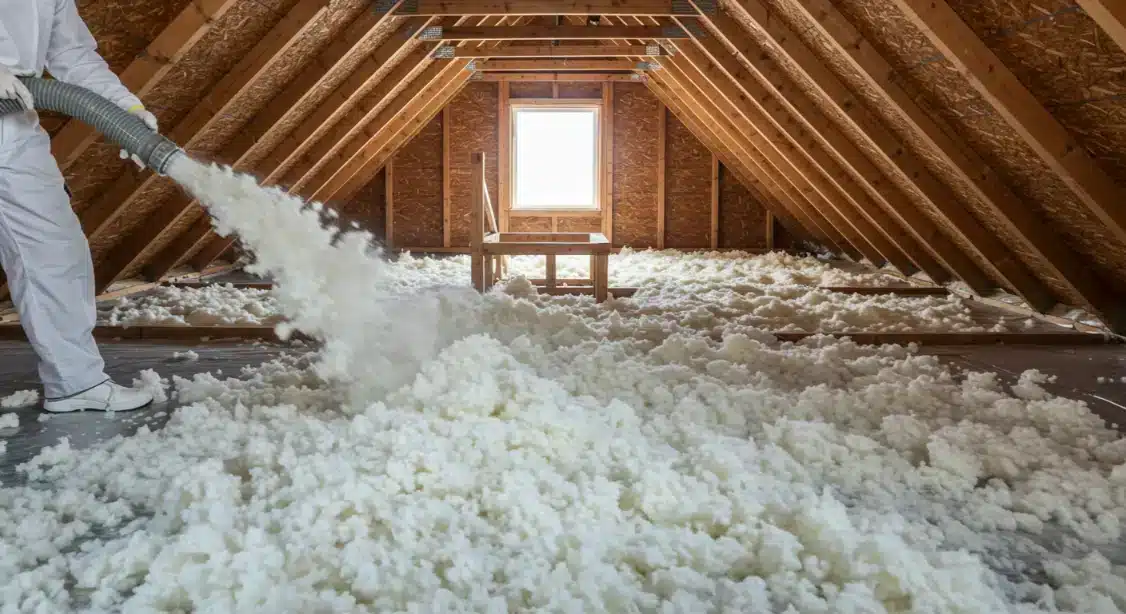
The blown-in form of fiberglass consists of loose fibers or fiber pellets installed using pneumatic equipment. It conforms to irregular spaces and fills around obstructions, making it a practical choice for both new construction and retrofits.
Key longevity factors for fiberglass:
- Settling: Loose-fill fiberglass settles less than cellulose over time, especially in attic applications where it is installed at the ceiling plane
- Moisture resistance: Fiberglass does not absorb or retain water the way cellulose does. It is highly resistant to mold growth, with tests showing mold only appears under exceptional circumstances (96% or higher relative humidity, or saturation) (Wikipedia – Glass Wool)
- Structural stability: The glass fibers maintain their shape and form without compacting, which means the insulation retains its installed R-value longer
- No biological degradation: Since fiberglass is inorganic, it cannot rot, decay, or support biological growth
Cellulose Blown-In Insulation
Cellulose insulation is manufactured primarily from recycled newspaper (75-85% post-consumer waste) treated with fire retardant chemicals such as boric acid and ammonium sulfate. The borate treatment provides Class I fire resistance, pest deterrence, and some mold resistance. Detailed data on its performance and composition can be found at Wikipedia – Cellulose Insulation.
Cellulose is available in several forms for blown-in applications: dry loose-fill, wet-spray, and stabilized. The dry loose-fill method is the most common retrofit technique, where cellulose is blown through holes drilled into wall or ceiling cavities.
Key longevity factors for cellulose:
- Settling: Standard dry cellulose can settle 13% to 20% after installation, which may leave uninsulated gaps at the top of wall cavities or between floors and insulation (Wikipedia – Cellulose Insulation)
- Moisture vulnerability: Cellulose absorbs and retains moisture more readily than fiberglass. Prolonged moisture exposure can reduce R-value, promote mold in some circumstances, and accelerate the breakdown of the paper fiber
- Weight: Cellulose weighs roughly three times as much per square foot as fiberglass for a given R-value (Wikipedia – Cellulose Insulation), which can stress ceiling structures in attic applications
- Chemical leaching: Over time, the borate fire retardant treatments can gradually lose effectiveness if exposed to prolonged moisture
Head-to-Head Comparison
| Factor | Fiberglass Blown-In | Cellulose Blown-In |
|---|---|---|
| Material Composition | Inorganic glass fibers and sand | Organic recycled paper fiber with borate treatments |
| R-Value per Inch | R-2.2 to R-2.7 | R-3.2 to R-3.8 |
| Settling Over Time | Minimal | 13% to 20% (standard loose-fill) |
| Moisture Resistance | High; does not absorb water readily | Lower; absorbs and retains moisture |
| Mold Resistance | Naturally resistant; only grows at 96%+ humidity | Some resistance from borates, but elevated risk when saturated |
| Fire Resistance | Naturally non-combustible | Requires borate chemical treatment for Class I rating |
| Typical Effective Lifespan | 80 to 100 years (optimal conditions) | 20 to 30 years (standard loose-fill) |
| Weight (per R-value) | Lighter | Roughly 3x heavier than fiberglass |
| Best Application | Attics, open spaces, retrofit top-ups | Dense-pack walls, cavities with irregular shapes |
Performance Over Time: What Really Happens in the Field
In real-world conditions, neither material performs perfectly forever. The DOE‘s Building Science Education program notes that blown-in insulation in existing attics should be installed after thorough air sealing and should meet current building code R-values for the climate zone. The actual lifespan of either material depends heavily on installation quality and environmental conditions.
Fiberglass aging concerns: While fiberglass fibers themselves do not degrade, performance can decline if the insulation is compressed, contaminated with dust and debris, or exposed to air circulation within the cavity. The DOE notes that some low-density fiberglass loose-fill installations may allow air circulation between the ceiling and attic in very cold temperatures, reducing effectiveness (DOE Insulation Fact Sheet).
Cellulose aging concerns: The primary longevity issue with cellulose is settling. As the material compacts, it can leave uninsulated gaps at the top of wall cavities, particularly in standard loose-fill applications. Dense-pack installation, which compresses the cellulose to a higher density within the cavity, largely eliminates settling. Wet-spray and stabilized cellulose formulations also include adhesives that reduce settling and maintain coverage.
A study cited by the University of Colorado School of Architecture and Planning compared two identical test structures, one with cellulose and one with fiberglass. The cellulose-insulated structure lost 26.4% less heat energy and tightened the building envelope more than 30% compared to fiberglass (Wikipedia – Cellulose Insulation). Guidelines for various applications and R-value comparisons are further detailed in the DOE/ENERGY STAR Insulation Fact Sheet.
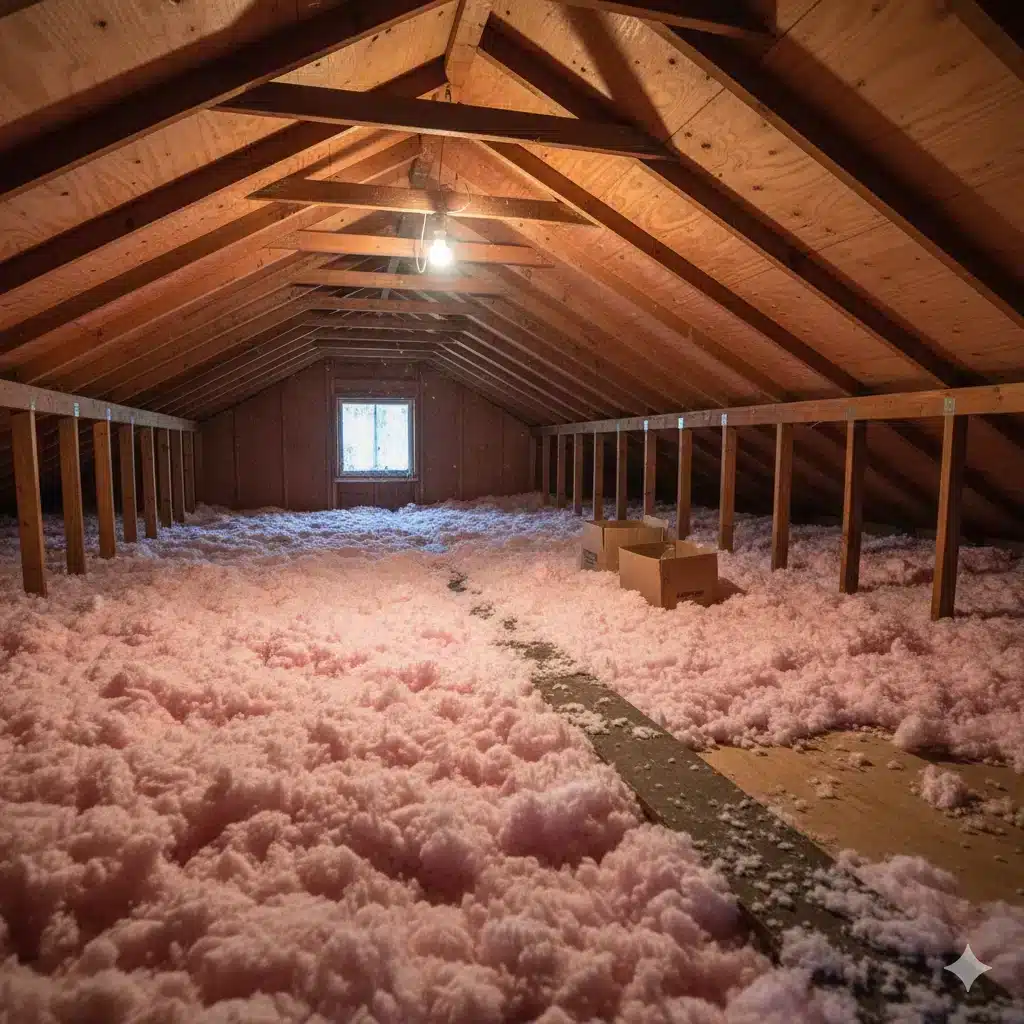
Factors That Influence Which Material Lasts Longer
- Installation method: Dense-pack cellulose reduces settling to near zero, closing the longevity gap with fiberglass significantly. Standard loose-fill cellulose in attics will settle and may need topping off after 15 to 20 years
- Moisture control: Both materials require proper ventilation and moisture management. Persistent moisture or water exposure will degrade either material, but cellulose suffers more due to its organic composition
- Climate zone: In humid climates, fiberglass has a clear longevity advantage. In dry climates, cellulose performs well and its higher R-value per inch provides better initial thermal performance
- Application type: For attic floor insulation, fiberglass tends to maintain consistent coverage longer. For wall cavities, dense-pack cellulose provides excellent air sealing and stability
- Building age and structure: Older homes with weaker ceiling structures may not support the weight of cellulose in attics. Our professionals always assess structural capacity before recommending a material
- Existing insulation: Both materials can be installed over existing insulation, but the DOE warns that placing higher-density material over lower-density insulation can compress the lower layer and reduce its R-value (DOE Insulation Fact Sheet)
Real-World Scenarios: Which Option Fits
| Scenario | Property Type | Recommended Option | Why |
|---|---|---|---|
| 1970s home with no existing attic insulation | Single-family residence | Fiberglass blown-in attic | Lightweight, resists settling, inorganic material lasts decades without maintenance in vented attic |
| Historic home retrofit with irregular wall cavities | Pre-1940 two-story residence | Dense-pack cellulose | Fills irregular cavities completely, superior air sealing, settling eliminated by dense-pack method |
| New construction with open wall cavities | New build, production framing | Cellulose wet-spray | Fills around obstructions, adhesives prevent settling, higher R-value per inch |
| Attic top-up over existing fiberglass batts | Ranch-style home, 1990s construction | Fiberglass blown-in | Lightweight addition over existing batts, minimal settling risk, compatible layering |
| Humid climate coastal property | Single-story near coastline | Fiberglass blown-in | Superior moisture resistance, no organic material to support mold, naturally non-combustible |
Who Cellulose Is Best For (And Who Should Avoid It)
Cellulose is ideal for:
- Properties where superior air sealing in wall cavities is the primary goal
- Projects where dense-pack installation methods are feasible and the installer has verified experience
- Dry climate zones where moisture exposure risk is low
- Builders and homeowners prioritizing recycled content and lower embodied energy
Cellulose may NOT be the right fit for:
- Homes with known moisture problems, roof leaks, or inadequate ventilation
- Attics with weak ceiling structures that cannot support the additional weight
- Projects where the budget does not allow for dense-pack or stabilized cellulose (standard loose-fill will settle)
Who Fiberglass Is Best For (And Who Should Avoid It)
Fiberglass is ideal for:
- Attic floor applications where long-term stability without maintenance is the priority
- Properties in humid or coastal climates where moisture resistance matters
- Retrofit projects adding insulation over existing material without removing the old layer
- Budget-conscious projects where material longevity is the primary concern
Fiberglass may NOT be the right fit for:
- Wall cavities with complex obstructions where complete fill is difficult to achieve with loose fibers
- Situations where maximum R-value per inch is needed and cavity depth is limited
- Properties where the homeowner wants the highest recycled content and lowest embodied energy material
Get a Professional Insulation Assessment
At All Foam & Insulation, our experienced team evaluates every project individually, considering the building structure, climate conditions, existing insulation, and budget to recommend the material that will perform best for years to come. Whether blown-in fiberglass or cellulose is the right call for your property, we install it to the standards that ensure maximum longevity and thermal performance.
Reach our team at (541) 826-9600 or email [email protected] to discuss which blown-in insulation option makes the most sense for your next project.
Frequently Asked Questions
Does cellulose insulation need to be replaced more often than fiberglass?
In standard loose-fill applications, cellulose can settle and lose effectiveness over 20 to 30 years and may need topping off. Fiberglass, being inorganic, does not degrade the same way and can perform effectively for 80 to 100 years when kept dry.
Can blown-in cellulose last as long as fiberglass?
Dense-pack and stabilized cellulose installations significantly reduce settling and can extend effective lifespan considerably. With proper installation, moisture control, and no settling, cellulose can perform well for decades, though it remains more vulnerable to moisture damage than fiberglass.
Which blown-in insulation is better for humid climates?
Fiberglass is the better choice in humid climates. It does not absorb or retain moisture, is naturally resistant to mold growth, and will not degrade when exposed to high humidity. Cellulose absorbs moisture more readily, which can reduce its R-value and shorten its effective lifespan.
Does settling in cellulose really cause problems?
Yes, standard loose-fill cellulose can settle 13% to 20% over time, which may leave gaps at the top of wall cavities or between the insulation and floor above. These gaps allow air movement and reduce the overall thermal performance of the assembly.
Can I install blown-in insulation over my existing insulation?
Both materials can be installed over existing insulation in attics, but the DOE recommends careful assessment. You should not place a vapor barrier between the old and new layers, and you should account for the compression effect when stacking materials of different densities.
Sources
- Wikipedia – Glass Wool (Fiberglass Insulation) – Detailed article on fiberglass/glass wool composition, manufacturing from sand and recycled glass, thermal properties, mold resistance testing results, and health and safety classifications.
- Wikipedia – Glass Wool (Fiberglass Insulation) – Detailed article on fiberglass/glass wool composition, manufacturing from sand and recycled glass, thermal properties, mold resistance testing results, and health and safety classifications.
- DOE/ENERGY STAR Insulation Fact Sheet – U.S. Department of Energy publication covering all insulation types including blown-in loose-fill cellulose and fiberglass, R-value comparisons, installation methods, moisture control, and climate zone recommendations.
- DOE Building Science Education – Blown Insulation in Existing Attics – U.S. Department of Energy guidance on installing loose-fill blown cellulose and fiberglass insulation in existing vented attics, including air sealing requirements and code compliance.

- Faced vs. Unfaced Fiberglass Batts in Creswell, OR: Performance and Applications Compared - September 11, 2026
- How to Install Fiberglass Batt Insulation Between Floor Joists in Brookings, OR - September 11, 2026
- Fiberglass Batt Insulation Thickness: How Do You Choose the Right Size? - September 9, 2026