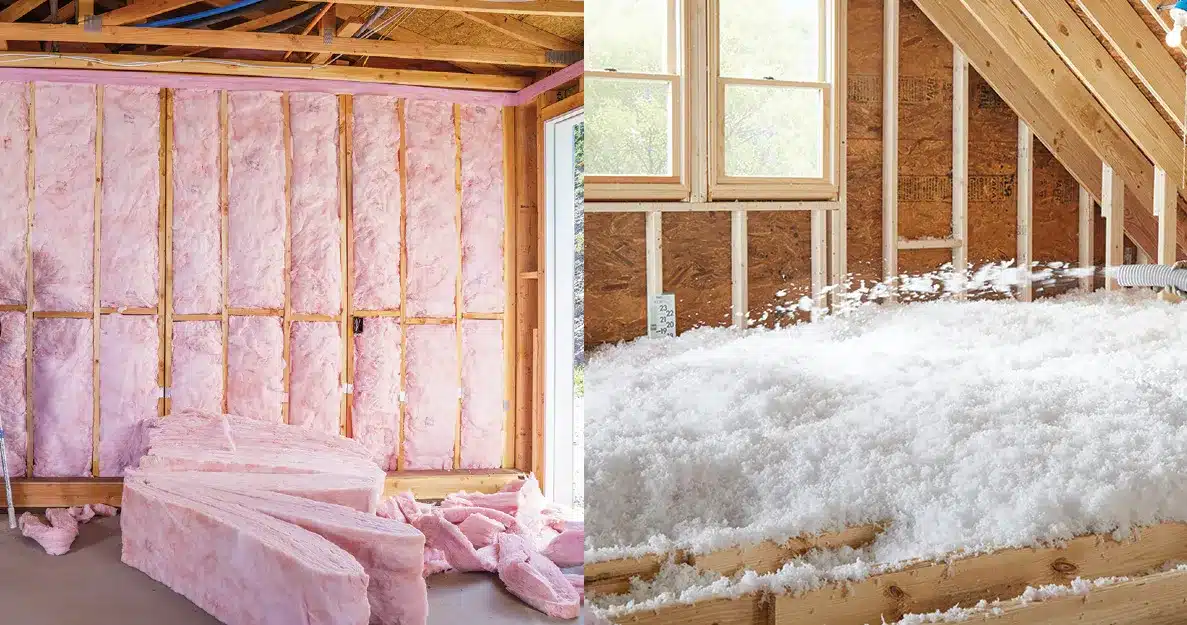
Choosing between blown-in insulation and fiberglass batt insulation is one of the most common decisions homeowners in Medford, Ashland, and the rest of Southern Oregon face when upgrading a home’s energy efficiency. Both materials slow heat transfer, but they behave very differently once they’re inside your walls or attic, and picking the wrong one for the application can leave you paying for insulation that isn’t actually doing its job.
This guide breaks down how each type performs, what it costs, and which one tends to work better for Oregon’s mix of cold, wet winters and hot, dry summers.
Quick Summary
- Blown-in insulation fills gaps, crevices, and irregular spaces better than batts, making it a strong choice for attics and older homes with uneven framing.
- Fiberglass batt insulation costs less upfront, installs quickly in standard stud and joist spacing, and is easier for a careful DIYer to handle.
- Blown-in cellulose typically settles 15–20% over time and may need topping off; fiberglass batts hold their shape but leave gaps if compressed or cut poorly.
- R-value per inch runs roughly R-2.2 to R-3.8 for blown-in materials and R-2.9 to R-3.8 for fiberglass batts, depending on the specific product.
- Neither option outperforms the other in every scenario. The right choice depends on the cavity you’re filling, your budget, and how the home was originally framed.
What Blown-In Insulation Actually Does
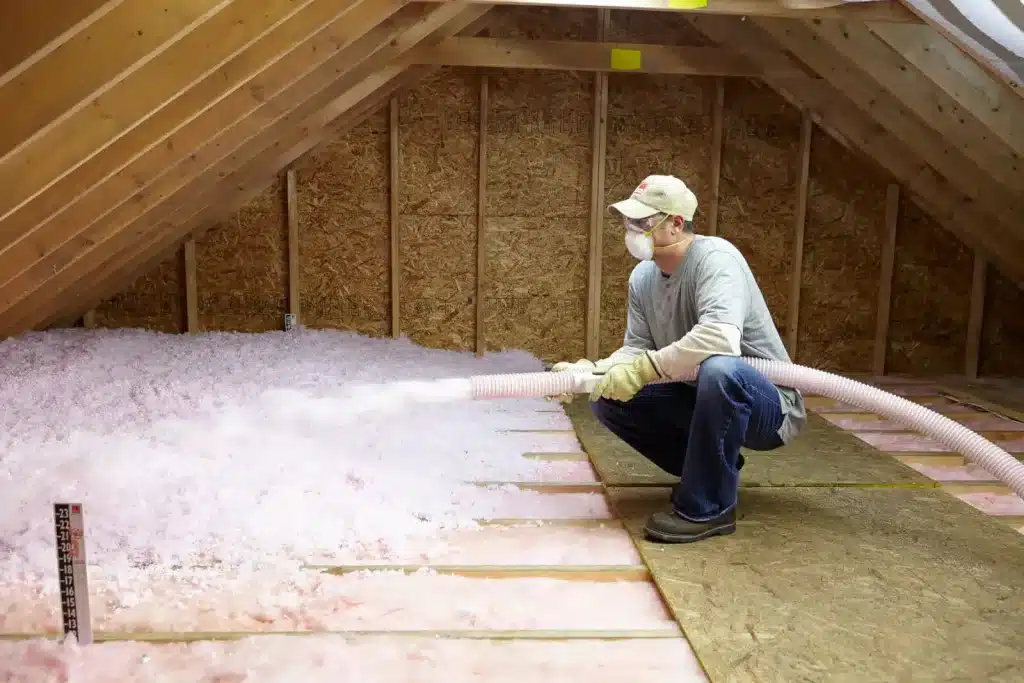
Blown-in insulation, sometimes called loose-fill insulation, is installed with a blowing machine that distributes small particles of fiberglass or cellulose evenly across an attic floor or into a wall cavity through a hose. Because the material is loose rather than pre-cut, it settles into the odd corners, around wiring, and behind plumbing that a rigid batt simply can’t reach. That gap-filling ability is the main reason blown-in insulation performs so well in older homes where framing isn’t perfectly square.
Cellulose blown-in insulation is made largely from recycled paper treated with a fire retardant, which appeals to homeowners who want a lower-impact material. Blown-in fiberglass is the lighter-weight option and resists moisture slightly better, though it doesn’t pack as densely into gaps. Depending on the material, blown-in insulation delivers an R-value of roughly R-2.2 to R-3.8 per inch.
Understanding Fiberglass Batt Insulation
Fiberglass batt insulation is the pink or yellow rolled material most people picture when they think of home insulation. It’s manufactured from fine spun glass fibers and sold in pre-cut panels or rolls sized to fit standard stud and joist spacing, sometimes with a paper or foil facing that acts as a vapor barrier. Each inch of standard fiberglass batt blocks roughly R-2.9 to R-3.8 of heat flow, which is comparable to blown-in material on paper.
Where batts fall short is installation quality. If a batt is compressed to fit around a pipe, cut short, or left with even a small gap at the edge, its real-world R-value drops noticeably below the rated number. That’s why professionally installed fiberglass batts consistently outperform DIY jobs in side-by-side attic tests, even though the material itself is identical. Batts remain a solid, budget-friendly choice for new construction with standard framing, and for interior walls where soundproofing matters more than air sealing.
Blown Insulation vs Fiberglass: How They Actually Compare
When homeowners search blown insulation vs. fiberglass, they’re usually trying to solve one of three problems: a cold room, a high energy bill, or an attic that clearly wasn’t insulated correctly the first time. Here’s how the two stack up on the factors that matter most.
Coverage and gap-filling: Blown-in insulation wins decisively here. Loose-fill material flows around obstructions, wiring, and irregular framing in a way that pre-cut batts can’t match, which is why attics with lots of penetrations tend to perform better with blown-in material.
Cost: Fiberglass batts are typically the cheaper option upfront, both for materials and labor, because installation is faster and requires less specialized equipment.
Long-term performance: Blown-in insulation can settle over time, particularly cellulose, which sometimes requires a top-off application after several years. Batts don’t settle, but they’re far more sensitive to installation errors that permanently reduce performance.
Soundproofing: Blown-in insulation, especially dense-packed cellulose, tends to reduce noise transfer better than batts due to its density and ability to eliminate air gaps.
Building science guidance: According to the U.S. Department of Energy’s overview of insulation materials and installation methods, achieving the rated R-value for any insulation type depends heavily on installation quality and complete cavity fill, not just the material chosen. That’s consistent with what shows up in the field: the material matters less than whether it was installed correctly and to the recommended depth.
R-Value Isn’t the Whole Story
A common misconception is that a higher R-value number always means better performance. In practice, an insulation’s rated R-value assumes a perfect, gap-free installation, which rarely happens with either blown-in insulation or batts unless the work is done by an experienced crew. ENERGY STAR’s published R-value benchmarks by climate zone are a useful starting point for figuring out how much insulation your home actually needs before comparing materials, since the target R-value for an Oregon attic is very different from what’s recommended in a milder climate.
For attic applications specifically, blown-in insulation vs batts tends to favor blown-in material because attics have far more obstructions, uneven joist spacing, and edge gaps than a standard wall cavity. In a straightforward wall cavity with no wiring or plumbing to work around, a properly cut and fitted batt can perform nearly as well.
Which Option Fits Southern Oregon Homes Best
Southern Oregon’s climate swings between cold, wet winters and hot, dry summers, which puts a premium on air sealing as much as raw R-value. Blown-in insulation tends to perform well here because it fills the small gaps that let cold air infiltrate during winter and reduces outside noise, which matters in denser neighborhoods. Homeowners who’ve dealt with uneven upstairs temperatures in older homes often find that topping up settled blown-in insulation, or adding it where none existed before, resolves the problem more effectively than swapping in new batts.
Fiberglass batts still make sense for newer construction with standard, well-sealed framing, or for projects where budget is the primary constraint. Moisture-resistant batt products have also improved, making them a reasonable option for humid crawl spaces when installed correctly.
Common Myths About Insulation
“A higher R-value always means better performance.” Not necessarily. Installation quality and complete cavity fill matter as much as the material’s rated R-value.
“Blown-in insulation only works in attics.” It’s also used in wall cavities and floors, particularly in retrofit projects where drilling small access holes is more practical than removing drywall.
“Fiberglass insulation is unsafe to be around.” Modern fiberglass products are manufactured to much safer standards than older versions, though proper PPE during installation is still recommended.
Choosing the Right Insulation for Your Project
The better material depends on the specific job. Blown-in insulation generally makes more sense for attics, retrofits, and any space with irregular framing or numerous obstructions. Fiberglass batt insulation tends to be the more practical choice for new construction with standard wall cavities, interior soundproofing, and budget-conscious projects where the framing is clean and accessible.
Both materials can deliver decades of reliable performance when installed correctly and matched to the right application. If you’re unsure which is the better fit for your specific home, a professional insulation assessment is the most reliable way to compare your options against your actual attic and wall conditions rather than guessing from a product label.
Frequently Asked Questions
How do I know which insulation is best for my home?
It depends on the space you’re insulating. Attics and irregular framing generally favor blown-in insulation, while standard wall cavities in new construction often do well with fiberglass batts. A home energy assessment can confirm which option fits your specific situation.
Is blown-in insulation more expensive than fiberglass batts?
Blown-in insulation typically costs more upfront due to specialized equipment and labor, but it can reduce long-term heating and cooling costs by sealing gaps that batts often miss.
How long does insulation last?
Both materials can last several decades when installed correctly. Blown-in insulation may settle over time and occasionally need a top-off, while batts hold their shape but are more sensitive to installation errors.
Can I install insulation myself?
Fiberglass batts are the more DIY-friendly option for straightforward wall cavities. Blown-in insulation requires a blowing machine and even distribution, so it’s generally best handled by an experienced installer.
Does blown-in insulation contain fiberglass?
It can. Blown-in insulation is most commonly made from either fiberglass or cellulose, and the two materials have different R-values, weights, and moisture characteristics. Better and safer.