If you’ve been comparing insulation options, you’ve probably come across the closed-cell spray foam R-value of R-6 to R-7 per inch. That high thermal performance makes it a popular choice for attics, walls, and crawl spaces where maximizing insulation in limited space is important. Still, the per-inch rating is only part of the picture. For a full breakdown of how closed-cell foam performs across an entire building, this closed-cell foam insulation guide is a useful starting point.
Quick Overview
Closed-cell spray foam has an R-value of approximately R-6 to R-7 per inch, making it one of the highest-performing insulation materials available. Since R-value is cumulative, the total insulation depends on the thickness installed, while added benefits like air sealing and moisture resistance further improve overall performance.
Let’s break down what this rating means, how it’s calculated, and how much insulation your project may actually need.
What Is R-Value, and Why Does It Matter?
R-value measures how well a material resists heat flow. The higher the number, the better the material keeps warm air in during winter and out during summer. It’s the standard homeowners, builders, and inspectors rely on to compare insulation types and confirm a project meets local code.
R-value is cumulative, meaning it adds up with thickness. That’s why the closed-cell spray foam insulation R-value per inch is usually listed first, then multiplied out for whatever total depth gets installed. Getting this number right matters because it directly affects how much heat transfer the insulation actually stops, and by extension, how much you spend heating and cooling the space.
Closed Cell Foam R Values: The Numbers
Closed Cell Foam R-Value: The Numbers
Closed-cell spray foam R-value typically ranges from R-6 to R-7 per inch, depending on the product’s formulation and density. This is the figure most manufacturers list on their spec sheets, and it’s nearly double what open-cell spray foam delivers.
Here’s what the R-value of closed-cell spray foam insulation looks like at common thicknesses:
| Thickness | Approx. R-Value (Closed Cell) |
| 1 inch | R-6 to R-7 |
| 2 inches | R-12 to R-14 |
| 3 inches | R-18 to R-21 |
| 4 inches | R-24 to R-28 |
| 5.5 inches | R-33 to R-38 |
So if a building code minimum calls for R-38 in an attic, roughly 5.5 to 6 inches of closed-cell foam gets you there, compared with 10 or more inches of some lower-density materials.
Why Closed Cell Foam Has a Higher R-Value Than Open Cell
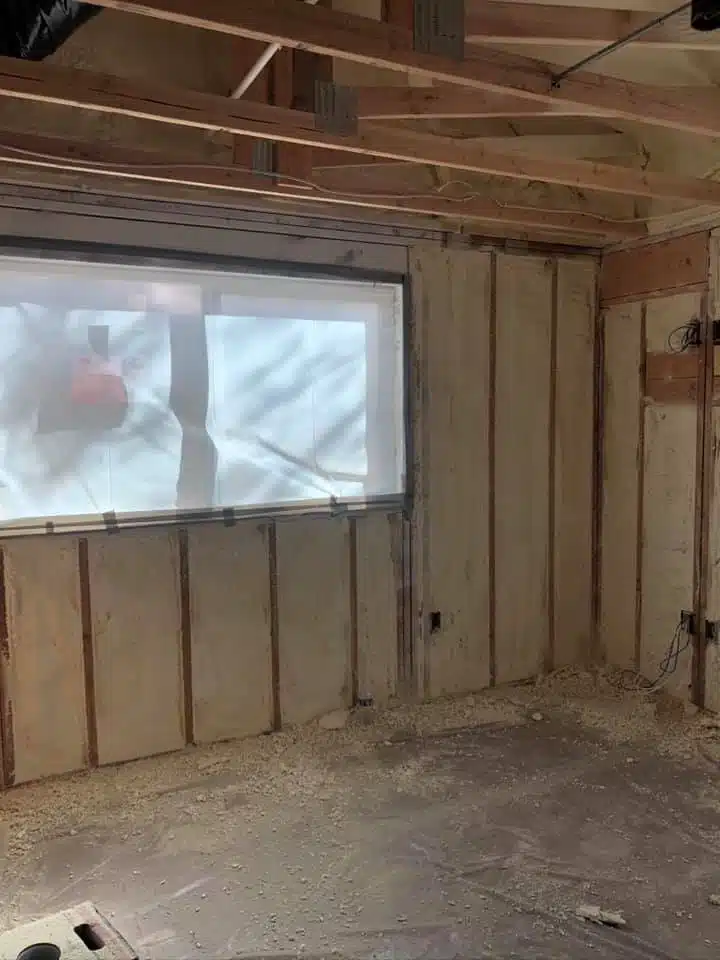
The difference comes down to structure. Closed-cell foam is made of tightly packed, fully sealed cells filled with a low-conductivity gas, which makes it denser and more resistant to heat transfer. Open-cell foam has a looser, sponge-like structure filled with air, which is why its per-inch rating runs lower. It’s still lighter, more affordable, and better for sound dampening.
Neither option is universally better; the right choice depends on the space. Interior walls and larger open cavities, where soundproofing matters more than maximum thermal resistance, are often a better fit for open-cell foam. Exterior walls, roofs, and crawlspaces with limited cavity depth usually call for closed-cell foam, since it delivers more resistance in a thinner layer. According to recommended R-value levels, the right target always depends on climate zone and the part of the house being insulated, not a single fixed number
R-Value Per Inch vs. Total R-Value: Don’t Mix These Up
This is the detail that trips up most homeowners researching insulation. The spray foam R-value per inch is a fixed number, but total R-value depends entirely on how thick the foam is installed. A 1-inch layer and a 4-inch layer of the same closed-cell foam perform very differently, even though it’s the same material.
When you’re comparing quotes, ask two things: what the spray foam insulation R-value per inch is, and what total thickness is actually planned. That combination is what determines real-world energy performance, not the per-inch number by itself. It’s also worth noting that a sealed foam layer does more than resist heat; it also blocks the moisture pathways that lead to mold and water damage inside walls, which is part of why closed-cell products hold up well in damp or flood-prone areas.
Closed Cell Spray Foam R-Value by Climate Zone
Building codes set minimum R-values by region, since colder climates need more insulation to stay efficient. As a general guide:
- Warmer climates: attic minimums often start around R-30
- Moderate climates: typically R-38 to R-49
- Colder climates: often R-49 and up
The Department of Energy’s insulation minimums outline how these requirements shift by region, though a local contractor can confirm the exact requirement for your county and assembly type.
Other Reasons Closed Cell Foam Performs Well
R value for closed-cell foam gets most of the attention, but it’s not the only factor behind its popularity:
- Air sealing: closed-cell foam creates a continuous air barrier at as little as 1 inch of thickness, cutting down on drafts that batt insulation can’t stop.
- Moisture resistance: its dense, sealed structure resists water absorption, making it a strong choice for crawlspaces and flood-prone areas.
- Structural strength: closed-cell foam adds rigidity to the wall or roof assembly it’s sprayed into, something open-cell foam and traditional insulation don’t offer.
How Many Inches of Closed Cell Spray Foam Do You Need?
The right thickness depends on three things: your climate zone’s code minimum, the area being insulated, and your budget.
- Check your climate zone’s code minimum for the area you’re insulating (attic, wall, or crawlspace).
- Match the minimum to a thickness using the per-inch rating of R-6 to R-7.
- Add a buffer for real-world variance in density and application, since field-installed foam can perform slightly differently than lab specs.
- Confirm with an on-site assessment, since actual foam depth should be calculated against your specific code requirement rather than a general chart.
As a rough starting point:
- Attics: 5 to 6 inches to hit R-38 to R-40 or higher in most zones
- Walls: 2 to 3 inches, often combined with a cavity-fill product for full depth
- Crawlspaces: 2 to 3 inches, primarily for moisture control and air sealing
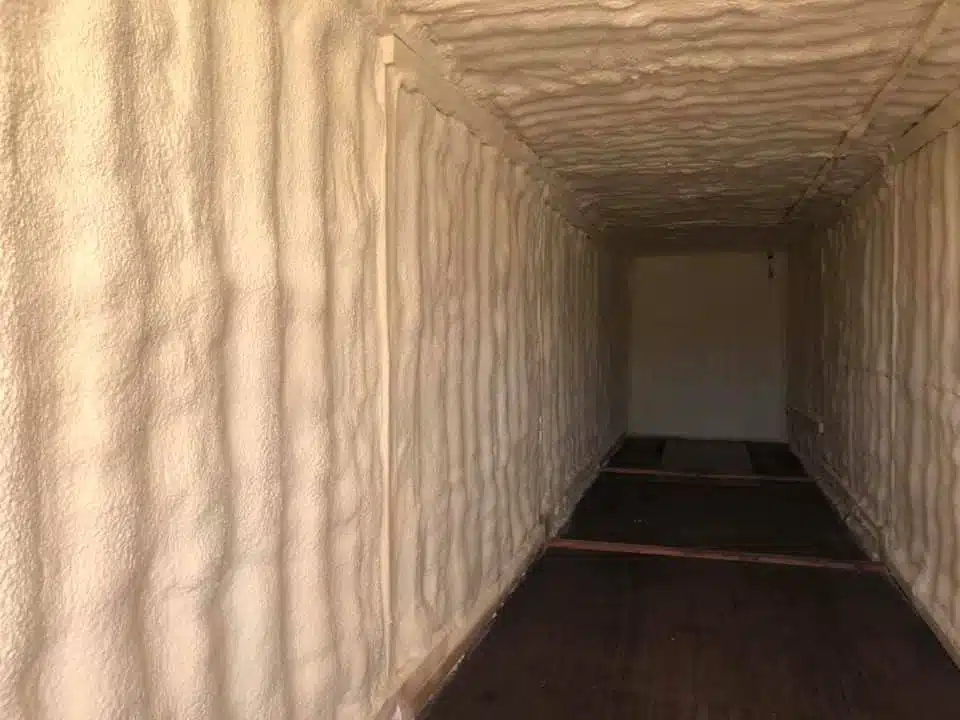
These are general ranges, not a substitute for proper measurement. If you want a clearer picture of what this looks like installed, closed-cell spray foam application is worth a look before you settle on a thickness.
Quick Recap
R-value tells you how the material performs. It doesn’t tell you how much you need; that part depends on your home’s construction, climate zone, and local code. Understanding the closed-cell spray foam R-value gives you the baseline; matching it to the right thickness is what actually delivers the energy savings.
Frequently Asked Questions
What is the R-value of closed-cell spray foam insulation?
It typically ranges from R-6 to R-7 per inch, depending on the product and density used.
Is closed-cell spray foam better than open-cell for R-value?
Yes. Closed-cell foam delivers roughly double the R-value per inch of open-cell foam, R-6 to R-7 versus R-3.5 to R-3.8, making it more efficient in thinner spaces.
How many inches of closed-cell spray foam do I need for R-38?
Around 5.5 to 6 inches of closed-cell spray foam can typically achieve R-38, depending on the product’s rated performance per inch.
Does closed-cell spray foam R-value change over time?
It can shift slightly with age and temperature, but the closed-cell structure helps it maintain consistent insulating performance compared with many other insulation materials.
Sources:
- ENERGY STAR: Recommended R-Value Levels
- U.S. Department of Energy: Insulation for New Home Construction

- Faced vs. Unfaced Fiberglass Batts in Creswell, OR: Performance and Applications Compared - September 11, 2026
- How to Install Fiberglass Batt Insulation Between Floor Joists in Brookings, OR - September 11, 2026
- Fiberglass Batt Insulation Thickness: How Do You Choose the Right Size? - September 9, 2026