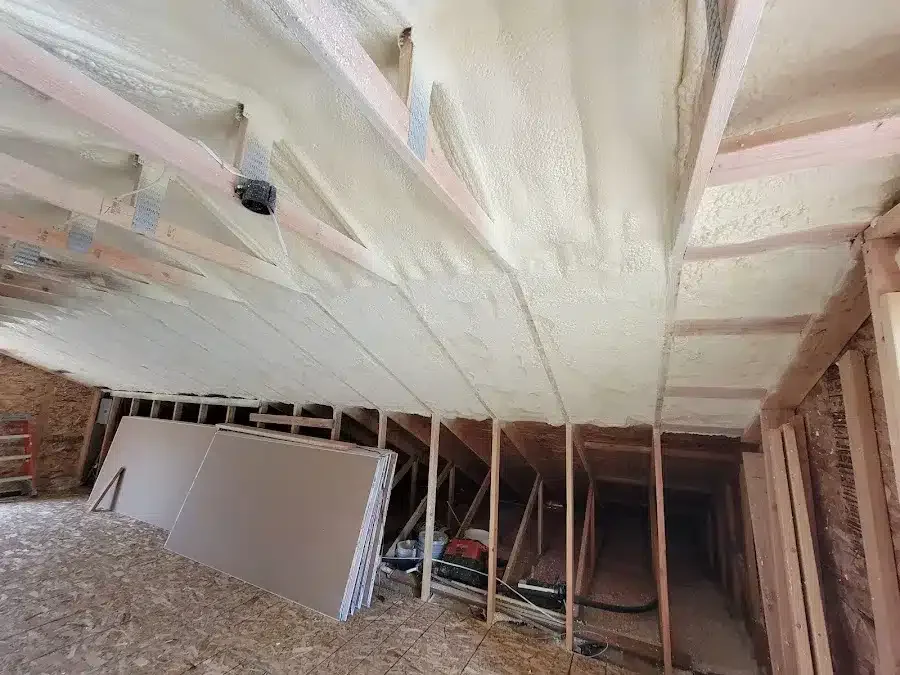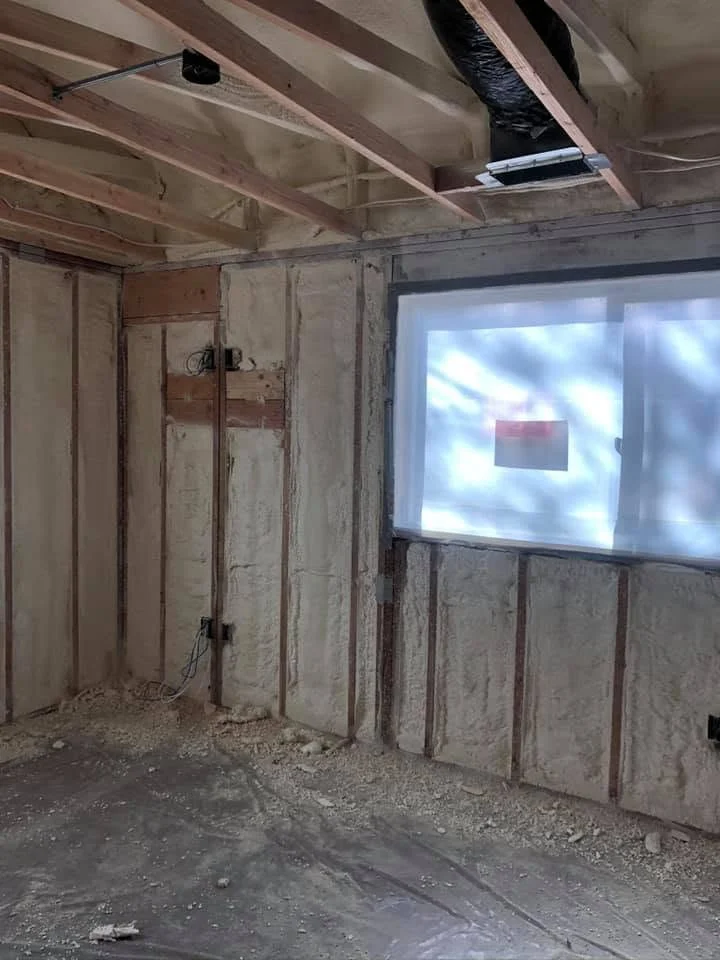

Spray foam insulation prevents moisture and mold in walls by sealing air leaks that account for more than 98% of water vapor movement in building cavities, while also acting as a thermal barrier that keeps wall surfaces above the dew point. Closed-cell spray foam, in particular, functions as both an air barrier and a Class II vapor retarder, blocking the two primary pathways through which moisture infiltrates wall assemblies and creates the conditions mold needs to grow.
TLDR / Key Takeaways
- Moisture control is the single most effective strategy for preventing mold in walls, and spray foam directly addresses the root cause rather than treating the symptoms.
- More than 98% of water vapor enters wall cavities through air movement, not diffusion, making air sealing the most effective moisture defense.
- Closed-cell spray foam delivers an R-value of approximately R-6.0 to R-7.0 per inch, outperforming fiberglass batts (R-2.9 to R-3.8 per inch) and cellulose (R-3.1 to R-3.8 per inch) at equivalent thickness.
- Closed-cell foam qualifies as a Class II vapor retarder (less than 1.0 perm), meaning it actively resists moisture diffusion through the wall assembly.
- Open-cell spray foam provides superior air sealing with a permeability that allows walls to dry in both directions, making it suitable for certain climate-specific applications.
- Mold requires moisture to grow, and by eliminating condensation surfaces inside wall cavities, spray foam removes the conditions mold needs to establish.
- Proper installation, including correct foam thickness and complete cavity fill, determines whether spray foam actually delivers its moisture-blocking performance.
How Moisture Gets Into Walls: The Science Behind the Problem
Moisture infiltration in wall assemblies is not a simple process. Water vapor moves through building envelopes in several ways, and understanding the mechanics is essential to choosing the right prevention strategy. According to the DOE’s Moisture Control guide, moisture travels through buildings by air movement, diffusion through materials, heat transfer, and generation from indoor activities like cooking and showering.
Of these four pathways, air movement dominates. The DOE reports that air currents account for more than 98% of all water vapor movement in building cavities. Air naturally flows from high-pressure areas to low-pressure areas through any available crack, gap, or penetration in the building envelope. When warm, moist indoor air meets cold surfaces inside a wall cavity, condensation forms. This condensation wets insulation, reduces its R-value, and creates the damp environment mold needs to thrive.
Diffusion through materials is a much slower secondary pathway. Most building materials slow moisture diffusion considerably, though they never stop it entirely. The temperature differential across a wall assembly causes the air within it to cool toward its dew point, and when water vapor reaches that threshold, it condenses on the first cold surface it encounters.
The Condensation Problem
Condensation inside walls is the direct precursor to mold growth. The dew point is the temperature at which water vapor in air begins to condense. When warm indoor air leaks into a wall cavity during cold weather, it cools rapidly as it approaches the exterior sheathing. If the temperature drops below the dew point before the air exits the cavity, moisture condenses on the sheathing, framing members, and insulation. The EPA’s mold guidance confirms that mold cannot grow without water or moisture, making condensation control the linchpin of any prevention strategy.
Why Traditional Insulation Falls Short
Standard insulation materials like fiberglass batts, cellulose, and mineral wool slow conductive heat flow, but they do not stop air movement. Gaps around batts, compression from plumbing and wiring, and voids from poor installation all create channels where warm, humid air can flow freely into the cavity. The DOE’s Types of Insulation resource notes that insulation effectiveness depends heavily on proper installation, and that compressed or poorly fitted insulation will not deliver its full rated R-value.
Traditional insulation also absorbs and retains moisture when condensation occurs. Wet fiberglass loses a significant portion of its thermal resistance, and cellulose can hold moisture against wood framing for extended periods. Neither material forms an effective air barrier, meaning moisture-laden air continues to circulate through gaps even after installation.
Insulation Performance Comparison
| Insulation Type | R-Value per Inch | Air Barrier | Vapor Retarder Class | Moisture Absorption |
|---|---|---|---|---|
| Closed-cell spray foam | R-6.0 to R-7.0 | Yes | Class II (< 1.0 perm) | Negligible |
| Open-cell spray foam | R-3.6 to R-3.8 | Yes | Class III (> 1.0 perm) | Low (vapor permeable) |
| Fiberglass batts | R-2.9 to R-3.8 | No | None (unfaced) | High when wet |
| Cellulose | R-3.1 to R-3.8 | No | None | High (hygroscopic) |
| Mineral wool | R-3.3 to R-4.2 | No | None | Low to moderate |
| Rigid foam board (XPS) | R-5.0 | No (joints leak) | Class II | Negligible |
Values sourced from DOE Insulation Materials and DOE Vapor Retarders references.
How Spray Foam Insulation Stops Moisture and Mold
The DOE’s Types of Insulation page describes sprayed-foam insulation as a material that can fill even the smallest cavities, creating an effective air barrier that eliminates the primary pathway for moisture intrusion.
Closed-Cell Spray Foam: The Complete Barrier
Closed-cell spray foam is a high-density polyurethane material in which the cells are closed and filled with a low-conductivity gas. According to the DOE’s Insulation Materials reference, closed-cell polyurethane foam has a higher R-value per inch than nearly any other common insulation material, typically in the R-6.0 to R-7.0 range. Beyond its thermal performance, closed-cell foam offers two distinct moisture-blocking properties:
Air sealing: The foam expands as it cures, filling gaps, cracks, and penetrations around plumbing, electrical wiring, and framing irregularities. This eliminates the air leakage pathways responsible for 98% of moisture movement into wall cavities.
The DOE’s Vapor Barriers guide classifies materials in this category alongside unfaced polystyrene and plywood, confirming that closed-cell foam actively slows moisture diffusion through the wall assembly.
Together, these properties mean that closed-cell spray foam blocks both the dominant air-transport pathway and the secondary diffusion pathway, creating a wall assembly that resists condensation formation and the mold growth that follows.
Open-Cell Spray Foam: Air Sealing with Breathability
Open-cell spray foam uses air as its blowing agent and has a lower density, spongy texture. While its R-value per inch is lower than closed-cell foam, it still forms an effective air barrier that eliminates the vast majority of moisture-carrying air leakage. Open-cell foam is vapor permeable, classified as a Class III vapor retarder or higher, which means it allows the wall assembly to dry in both directions. In certain climate zones and wall assemblies, this drying potential can be advantageous because it prevents trapped moisture from accumulating against framing members.
Our team evaluates each project individually to determine whether closed-cell or open-cell spray foam is the better choice based on climate zone, wall construction, and existing moisture conditions.
Real-World Scenarios: Spray Foam Preventing Wall Damage
We have encountered many situations where moisture was actively damaging walls and spray foam provided the solution. Here are representative examples from our experience:
| Scenario | Home Type | Problem | Solution | Outcome |
|---|---|---|---|---|
| 1960s ranch renovation | Single-family, stick frame | Chronic mold behind bathroom drywall from persistent condensation in poorly insulated walls | Closed-cell spray foam in exterior walls and bathroom cavity | Condensation eliminated, mold has not returned |
| New construction energy build | Custom home, advanced framing | Builder wanted to prevent future moisture issues in a high-performance envelope | Closed-cell spray foam in all exterior wall cavities | Blower door test confirmed minimal air leakage, no moisture concerns after two winters |
| Basement remodel with mold history | Full basement, poured concrete walls | Moisture seeping through foundation walls causing mold on interior framed walls | Closed-cell spray foam applied directly to concrete foundation, then framed | Moisture transmission stopped, no recurring mold |
| crawlspace encapsulation | 1970s split-level, vented crawlspace | High humidity and mold growth on floor joists above damp crawlspace floor | Open-cell spray foam on crawlspace walls and rim joist | Humidity levels dropped, mold growth halted |
| Attic moisture and ice dams | Two-story colonial, vented attic | Warm air leaking into attic causing condensation on roof sheathing and ice dams | Closed-cell spray foam on attic floor and rim joist | Ice dams eliminated, attic dryness confirmed |
Actionable Strategies for Moisture Control with Spray Foam
Our professionals recommend a systematic approach to preventing wall moisture and mold through proper insulation. These steps apply to both new construction and retrofit projects:
- Identify and seal the air leakage pathways first. Before insulating, our team conducts a thorough assessment of the building envelope to locate gaps around windows, doors, plumbing penetrations, electrical boxes, and rim joists. Spray foam seals these pathways as part of the installation.
- Select the correct foam type for the climate zone and application. Closed-cell foam is the right choice for below-grade applications, basement walls, and any cavity where vapor resistance is needed. Open-cell foam works well for above-grade wall cavities in mixed climates where drying potential matters.
- Apply the correct thickness to achieve target R-values. The DOE Insulation guide provides R-value recommendations by climate zone. Our team calculates the foam thickness needed to meet or exceed those targets for each specific project.
- Verify complete cavity fill during installation. Gaps, voids, or uneven application create weak points where air can still carry moisture. Our installers are trained to achieve full coverage in every stud bay, around every penetration, and behind every obstruction.
- Ensure proper ventilation is maintained. Tightening the building envelope with spray foam or traditional insulation reduces uncontrolled air leakage, which means controlled mechanical ventilation becomes more important. Our team evaluates whether the existing HVAC system provides adequate fresh air exchange after insulation is installed.
- Address existing moisture problems before insulating. The EPA mold guide stresses that if a water problem exists, it must be fixed before cleanup and insulation, or mold will return. We always recommend resolving active leaks, drainage issues, and ventilation deficiencies before spray foam is applied.
Factors That Affect Spray Foam Performance Against Moisture
Several variables influence how effectively spray foam prevents moisture and mold damage in real-world conditions:
Foam thickness: The R-value delivered by spray foam scales directly with thickness. If the applied thickness falls short of the target, the thermal resistance may not be sufficient to keep interior wall surfaces above the dew point, allowing condensation to form.
Installation quality: Spray foam must be applied at the correct temperature, humidity, and yield rate. Off-ratio mixing, poor substrate preparation, or application in conditions outside the manufacturer’s specifications can result in foam that does not cure properly, leaving weak points in the air barrier.
Climate zone: The temperature differential across the wall assembly determines condensation risk. Homes in colder climates face more severe indoor-to-outdoor temperature differences, which raises the dew point inside the cavity and demands higher R-values and more effective air sealing.
Building age and construction type: Older homes often have balloon framing, unsealed top plates, and numerous penetrations that create extensive air leakage pathways. The wall assembly type, whether standard stud frame, advanced framing, or masonry with furring, affects how spray foam interacts with the existing structure.
Existing moisture conditions: Spray foam applied over damp framing or wet substrates can trap moisture inside the wall, accelerating rot rather than preventing it. Pre-installation moisture testing and remediation are essential when working with existing structures that have a history of water intrusion.
Vapor retarder placement: The DOE’s Vapor Barriers guide states that vapor retarders should be installed on the warm side of the assembly in cold climates. When closed-cell spray foam serves as the vapor retarder, its position within the wall cavity matters for overall moisture management.
Get Expert Help Protecting Your Walls
All Foam & Insulation has the experience and specialized equipment to assess your building’s moisture vulnerabilities and recommend the right spray foam solution for your specific situation. Our team handles everything from initial evaluation through professional insulation installation, ensuring your walls stay dry, mold-free, and thermally efficient for the long term.
Call us at (541) 826-9600 or email [email protected] to get started on your project.
Frequently Asked Questions
Can spray foam insulation be installed over existing mold?
A: No. The EPA advises that all mold must be cleaned and the underlying moisture problem fixed before any insulation is installed. Spraying foam over active mold can trap moisture and spores inside the wall cavity.
Does spray foam insulation completely eliminate the need for a separate vapor barrier?
Closed-cell spray foam functions as a Class II vapor retarder on its own, but some building codes may still require an additional vapor barrier depending on your climate zone and wall assembly design. Our team ensures every installation meets local code requirements.
Is closed-cell or open-cell spray foam better for preventing mold?
Closed-cell foam is generally the stronger choice for mold prevention because it provides both air sealing and vapor resistance. Open-cell foam seals air leaks effectively but allows vapor to pass through, which is beneficial in some climate-specific applications where walls need to dry outward.
How quickly can mold grow in walls once moisture is present?
According to the EPA, mold can begin growing indoors within 24 to 48 hours when moisture is present on surfaces. This is why rapid air sealing and moisture control are so important.
Can spray foam insulation trap moisture inside a wall and make mold worse?
When installed correctly on a dry substrate, spray foam prevents moisture from entering the cavity. However, if foam is applied over wet framing or in a wall with unresolved water intrusion, it can indeed trap moisture. Proper assessment before installation is essential.
Sources
- DOE – Moisture Control – Comprehensive guide on how moisture moves through buildings, condensation mechanics, and strategies for controlling moisture in walls, foundations, and crawlspaces.
- EPA – A Brief Guide to Mold, Moisture and Your Home – Official EPA guidance on mold prevention, health effects, cleanup procedures, and the fundamental principle that moisture control is the key to mold control.

- Fiberglass Batt vs. Roll Insulation in Ashland, OR: What’s the Difference? - October 15, 2026
- How Does Thermal Bridging Affect Closed-Cell Spray Foam Performance in Medford, OR? - October 13, 2026
- Why Do Medford Commercial Buildings Benefit From Closed-Cell Spray Foam? - October 13, 2026