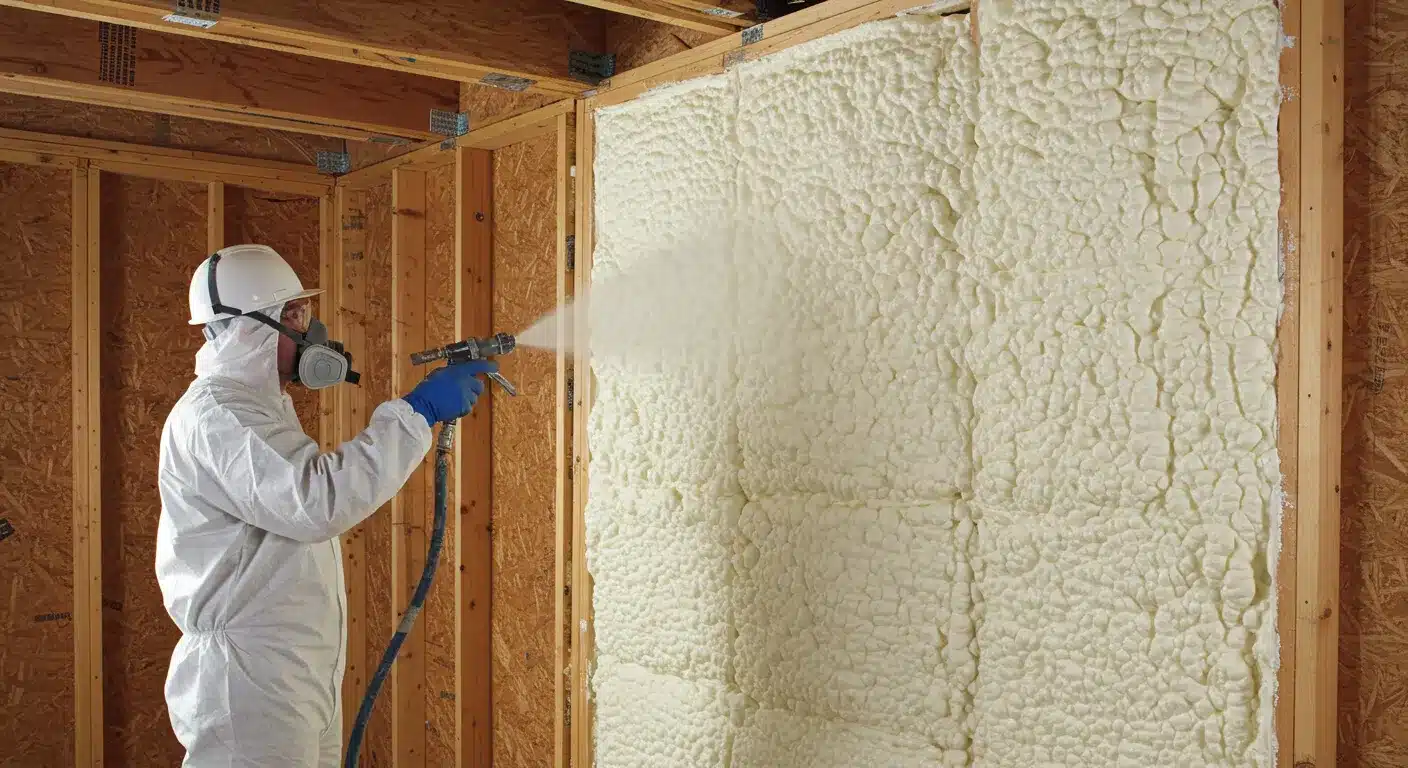
Applying cold-weather spray foam insulation is more common than most homeowners realize, but it isn’t as simple as pointing a spray gun at a wall. Temperature affects how the foam adheres, expands, and cures, which directly impacts long-term insulation performance. Understanding spray foam temperature control and how to prepare for a low-temperature install is the difference between a durable air seal and a job that has to be redone. For a broader look at how this material performs across seasons and applications, this closed-cell spray foam insulation guide breaks down the chemistry and performance factors in more detail.
TL;DR
- Spray foam insulation cold-weather application is possible, but most standard formulas need substrate temperatures above 40°F to cure properly.
- Specialized cold-weather formulas can work in temperatures as low as 20°F, though performance starts to drop below that point.
- Spray foam temperature control during storage (ideally 70°F to 80°F) matters as much as the job-site temperature.
- Closed-cell foam generally handles cold and moisture better than open-cell foam.
- Pre-warming surfaces, using thin layered passes, and allowing extra curing time all help offset cold-weather challenges.
- Below 20°F, delaying the project is usually the safer and more cost-effective choice.
Why Temperature Sensitivity Matters for Spray Foam
Spray foam insulation relies on a chemical reaction between two components, polyol resin and isocyanate. Temperature directly influences the speed and completeness of this reaction. When the material or the surface is too cold, the foam may not expand fully or bond to the substrate as designed, leaving gaps that undercut the whole point of the installation. According to the Centers for Disease Control and Prevention, isocyanates are reactive compounds commonly used in insulation, adhesives, and coatings, which is part of why precise application conditions matter for both performance and safety.
Surface and Ambient Conditions That Affect Application
- Substrate temperature: the surface receiving the foam should generally stay within the manufacturer’s recommended range, typically above 40°F.
- Ambient temperature: cold air slows curing and can cause inconsistent expansion across the surface.
- Humidity and moisture: excess moisture on a cold substrate can lead to shrinkage or weak adhesion.
Ideal Spray Foam Insulation Temperature Range
Most manufacturers recommend storing spray foam components between 70°F and 80°F and applying them to substrates that are at least 40°F, though some professional-grade closed-cell products are formulated to tolerate colder surfaces. Staying within the recommended spray foam insulation temperature range protects both the expansion rate and the final R-value of the cured foam. Outside that window, foam can expand unevenly, take far longer to set, or fail to bond correctly to the substrate.
Best Practices for Spray Foam Application in Cold Weather
Pre-Warm Materials and Equipment
Keeping spray foam components warm before application is one of the most effective forms of control spray foam temperature management available to installers. Storing materials in a temperature-controlled space and using heated hoses helps maintain the right consistency during spraying, which is standard in how our team approaches closed-cell spray foam projects year-round, including in colder months.
Adjust Spray Technique
- Apply thin layers: multiple thin passes rather than one thick layer improve adhesion and expansion.
- Extend curing time: cold temperatures slow the process, so extra time between layers is often necessary.
- Watch expansion closely: foam may expand less predictably in cold conditions, so application rates should be adjusted as needed.
Use Cold-Weather Formulations
Some spray foam products are formulated specifically for low-temperature use, with catalysts that help maintain proper expansion and adhesion even when conditions aren’t ideal. The Building Science Corporation’s residential spray foam guide is a useful independent reference for how these formulations perform across different climate zones.
Control the Job Site Environment
- Use temporary heating: portable heaters can help maintain workable spray foam application temperature conditions on site.
- Block drafts: wind and airflow cause temperature swings that make consistent application harder.
Common Cold-Weather Issues and How to Solve Them
| Issue | Cause | Solution |
| Poor adhesion | Cold substrate or moisture buildup | Pre-warm surfaces, remove moisture before spraying |
| Inconsistent expansion | Cold foam components | Store materials in a heated space beforehand |
| Extended curing time | Low ambient temperature | Use heaters and build in extra curing time |
| Brittle or shrunken foam | Rapid cooling after application | Apply in controlled, temperature-stable conditions |
How to Prepare for a Cold-Weather Spray Foam Application
- Check the forecast and site temperature. Confirm both ambient and substrate readings are within the product’s rated range before scheduling the job.
- Store materials at 70°F to 80°F. Keep components in a heated space or trailer until they’re ready to use.
- Warm the substrate. Use indirect heaters to bring surface temperatures up and eliminate frost or condensation.
- Apply in thin, controlled passes. This supports even expansion instead of forcing thick layers that cure unevenly.
- Maintain heat after application. Keep the space warm for at least 24 hours so curing can finish properly.
When to Avoid Spray Foam Application in Cold Weather
Many cold-weather challenges can be managed with the right prep, but extreme temperatures, generally below 20°F, can make spray foam application unreliable regardless of technique. If heating the environment or sourcing a cold-weather formulation isn’t practical, delaying the project until conditions improve is usually the better call for long-term performance.
Final Thoughts
Cold weather doesn’t have to rule out a spray foam project, but it does raise the stakes on preparation, material choice, and technique. Getting the spray foam insulation temperature requirements right from the start protects the R-value, air-sealing performance, and lifespan of the finished job. If you’re weighing your options for a winter install, this breakdown of how long spray foam takes to cure is a good next read, since cure time is one of the biggest variables in cold weather.
Frequently Asked Questions
1. Can spray foam insulation be applied below freezing temperatures?
Most standard spray foams need substrate temperatures above 40°F to cure properly. Some specialized cold-weather formulas can work down to around 20°F, though performance starts to drop off below that.
2. How do you prepare surfaces for spray foam in winter?
Surfaces should be dry and free of frost. Pre-warming the substrate and eliminating moisture beforehand both improve adhesion.
3. What happens if spray foam is applied incorrectly in cold weather?
Improper application in low temperatures can lead to weak adhesion, reduced expansion, or foam shrinkage, all of which reduce insulation efficiency.
4. Is open-cell or closed-cell spray foam better for cold weather?
Closed-cell spray foam is generally the better choice for cold climates because of its higher density and lower moisture absorption.
5. Can spray foam insulation crack in winter?
Yes. Foam applied incorrectly or exposed to sudden temperature swings can become brittle and crack over time.
6. Do I need a professional to apply spray foam in cold weather?
Professional installation helps ensure proper technique and equipment adjustments, which matter more in low-temperature conditions than in ideal weather.

- Faced vs. Unfaced Fiberglass Batts in Creswell, OR: Performance and Applications Compared - September 11, 2026
- How to Install Fiberglass Batt Insulation Between Floor Joists in Brookings, OR - September 11, 2026
- Fiberglass Batt Insulation Thickness: How Do You Choose the Right Size? - September 9, 2026