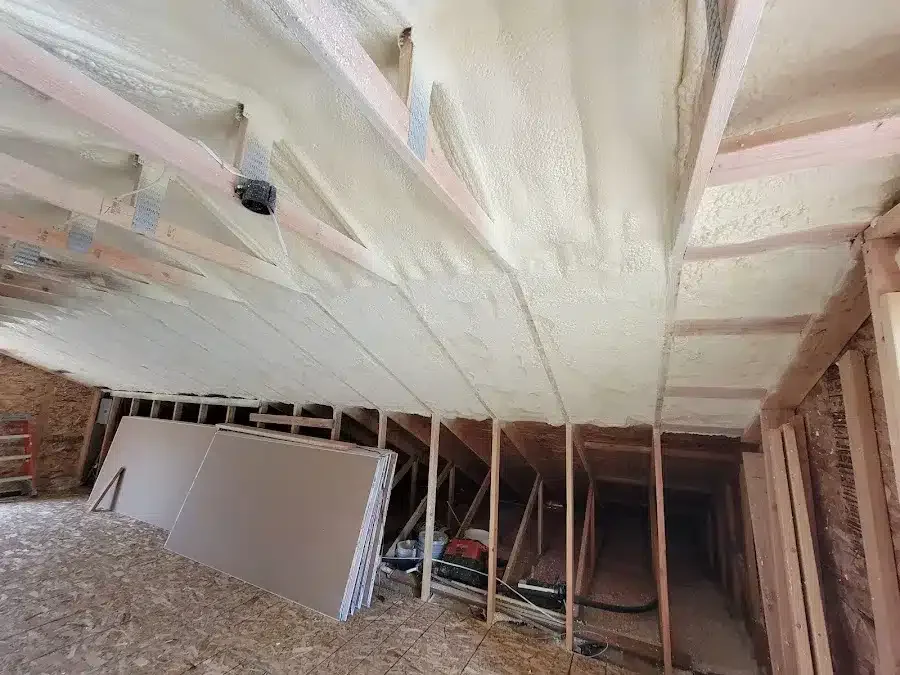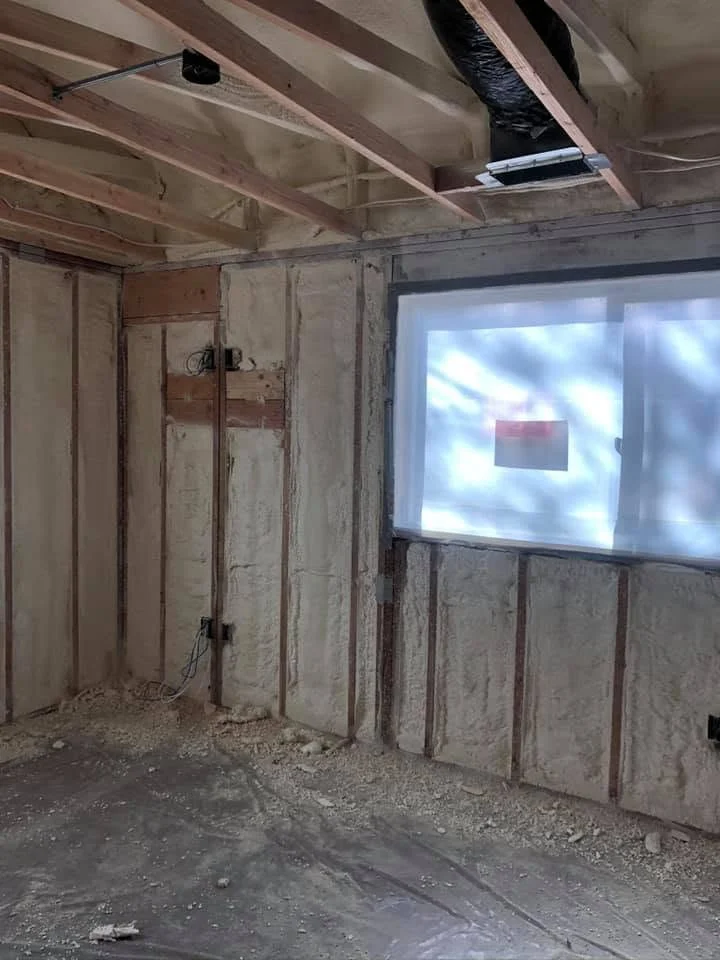

In Medford’s IECC Climate Zone 4C marine environment, open-cell spray foam works better as a cavity-fill insulation for walls, attics, and crawlspaces because it provides a seamless air barrier, superior sound dampening, and fills every gap and irregularity in the framing. Rigid foam board performs better as a continuous exterior insulation layer where eliminating thermal bridging across studs, plates, and headers is the priority. For most residential and commercial projects in Medford, the most effective approach combines both, but if we are comparing them head-to-head for the same application, the answer depends on whether you need cavity fill or continuous insulation. Open-cell spray foam delivers an R-value of approximately R-3.6 per inch, expands to fill voids completely, and acts as an air-impermeable insulation when sprayed to the minimum classified depth. Rigid foam boards, including EPS, XPS, and polyiso, range from R-3.2 to R-6.5 per inch depending on the type, and their primary advantage is providing a continuous thermal layer that bypasses the thermal bridging inherent in wood or steel framing. According to Building Science Corporation’s Residential Spray Foam Guide, both low-density open-cell and high-density closed-cell spray foam work in most climates for wall applications, with climate-specific considerations for vapor control.
TLDR / Key Takeaways
- Medford and Jackson County fall within IECC Climate Zone 4C (marine), which means moderate cold winters with wet conditions and hot, dry summers, per the IECC Oregon climate zone mapping.
- Open-cell spray foam delivers approximately R-3.6 per inch, provides a seamless air barrier, and fills every crack and gap in the framing cavity.
- Rigid foam board (EPS, XPS, polyiso) delivers R-3.2 to R-6.5 per inch and eliminates thermal bridging when applied as a continuous exterior layer.
- In Climate Zone 4C, open-cell spray foam works well in wall cavities and unvented attics when paired with an interior vapor retarder paint on the gypsum board.
- Rigid foam excels on the exterior of wall assemblies, keeping sheathing warmer and reducing condensation potential during cold, wet Medford winters.
- The Building America Solution Center notes that rigid foam on the exterior can reduce effective thermal bridging losses by 20% or more compared to cavity-only insulation.
- For the best long-term performance in Medford, combining rigid foam exterior sheathing with open-cell cavity-fill spray foam addresses both thermal bridging and air sealing.
- Oregon’s 2023 Oregon Residential Specialty Code mandates specific R-value minimums for Climate Zone 4C that both products can help meet.
Understanding Medford’s Climate Zone 4C
Medford, OR sits in IECC Climate Zone 4C, which the code designates as a marine climate. This classification matters because it directly determines the insulation requirements, vapor control strategies, and condensation risk for every building assembly. Marine climates are characterized by relatively mild but wet winters with moderate heating loads and dry, hot summers.
Jackson County is listed under Climate Zone 4C in the IECC Oregon code table, alongside other western Oregon counties like Douglas, Lane, and Coos. The “C” designation means the moisture regime is marine, which influences how water vapor moves through building assemblies. Winter humidity levels are elevated, and the temperature differential between indoor and outdoor surfaces creates conditions where condensation can form inside wall and roof assemblies if not properly managed.
For insulation selection, Zone 4C is moderate enough that neither open-cell nor rigid foam faces the extreme condensation risks found in Zones 5 through 8. However, the wet winter months still demand careful attention to vapor control and air barrier continuity.
How Open-Cell Spray Foam Performs in Zone 4C
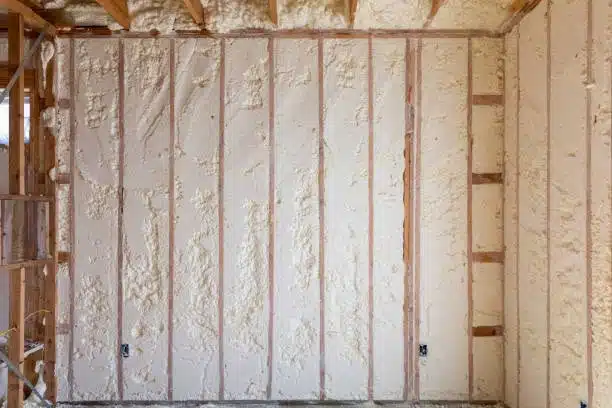
Open-cell spray foam is a low-density (approximately 0.5 pounds per cubic foot) insulation that expands significantly during application, filling cavities and sealing air leaks simultaneously. In a Zone 4C marine climate, it offers several advantages:
Air sealing: When sprayed to the minimum classified depth as an air-impermeable insulation, open-cell foam creates a continuous air barrier within the wall, ceiling, or floor cavity. This is particularly valuable in older Medford homes where framing irregularities make traditional batt insulation difficult to seal effectively.
Sound control: The open-cell structure absorbs sound transmission better than rigid foam board, making it a strong choice for interior partitions, party walls, and floor-ceiling assemblies.
Vapor permeability: Open-cell foam allows water vapor to pass through it at a relatively high rate, which means it does not trap moisture inside wall cavities. In a marine climate like Zone 4C, this vapor permeability can be both an advantage and a consideration. According to Building Science Corporation’s research on vapor retarders, open-cell foam can control diffusion in climates under approximately 4,500 heating degree days when interior winter relative humidity is controlled below 40%. Medford falls within this range, making open-cell viable without additional vapor barriers in most wall applications, though a vapor retarder paint on interior drywall provides added protection.
R-value: At approximately R-3.6 per inch, open-cell foam requires greater depth to reach target R-values compared to some rigid foam options. A typical 2×4 wall cavity (3.5 inches) yields roughly R-12.6, which meets code minimums for Zone 4C.
Where it works best: Wall cavities, attic floors (with proper ventilation), sound partitions, and retrofit applications where filling existing cavities without removing finishes is necessary.
How Rigid Foam Board Performs in Zone 4C
Rigid foam insulation comes in board form and is available in three primary types: expanded polystyrene (EPS), extruded polystyrene (XPS), and polyisocyanurate (polyiso). Each has distinct properties that affect performance in a marine climate.
The Building America Solution Center identifies continuous rigid insulation as an effective solution to thermal bridging through wood or metal framing. Wood framing accounts for roughly 24% of a conventionally framed wall area, and wood has only about one-fourth the thermal resistance of most insulation materials. Rigid foam applied to the exterior creates a continuous thermal blanket that addresses this weakness.
The Building America Solution Center identifies continuous rigid insulation as an effective solution to thermal bridging through wood or metal framing. Wood framing accounts for roughly 24% of a conventionally framed wall area, and wood has only about one-fourth the thermal resistance of most insulation materials. Rigid foam applied to the exterior creates a continuous thermal blanket that addresses this weakness.
Thermal bridging elimination: This is rigid foam’s primary advantage over open-cell spray foam. While open-cell fills the cavities between studs, it does nothing for the heat loss that occurs through the studs themselves. Rigid foam on the exterior wraps the entire wall assembly, bypassing the studs, plates, and headers entirely.
Condensation control: In cold climates, exterior rigid insulation reduces condensation problems in wood-framed walls by keeping the exterior sheathing warmer. The Building Science Corporation’s guideline on exterior rigid insulation notes that sufficient exterior rigid insulation can allow the traditional interior vapor control layer to be eliminated in some assemblies. In Medford’s Zone 4C climate, this is a meaningful benefit during wet winters.
Moisture management: Depending on the type selected, rigid foam can serve as part of the drainage plane and air barrier system. XPS and foil-faced polyiso have low vapor permeance and can function as vapor retarders. EPS is more vapor-permeable and is better suited for assemblies where drying potential is needed.
Installation considerations: Rigid foam boards require proper sealing of all seams with compatible tape, correct flashing details around windows and doors, and attention to cladding attachment methods. Thicker layers (over 1.5 inches) require furring strips for cladding attachment, which adds to the complexity and labor of the installation.
| Rigid Foam Type | R-Value per Inch | Vapor Permeance | Best Use in Zone 4C |
|---|---|---|---|
| EPS | 3.2 to 4.0 | 2.0 to 5.0 perms (Type II) | Exterior sheathing, below-grade, where drying is needed |
| XPS | 5.0 | 0.3 to 1.0 perms | Exterior walls where vapor retarder is beneficial |
| Polyiso (foil-faced) | 5.6 to 6.5 | Less than 0.5 perms | Exterior walls, roof assemblies, where high R-value needed |
Head-to-Head Comparison
| Factor | Open-Cell Spray Foam | Rigid Foam Board |
|---|---|---|
| R-Value per Inch | ~R-3.6 | R-3.2 to R-6.5 (varies by type) |
| Air Sealing | Seamless, fills all gaps | Only continuous if seams are taped perfectly |
| Thermal Bridging | Does not address bridging | Eliminates thermal bridging completely |
| Vapor Permeability | High (vapor-open) | Varies by type (EPS = high, XPS/polyiso = low) |
| Sound Control | Excellent | Poor to moderate |
| Installation | Requires professional equipment | Can be DIY but details are critical |
| Best Application | Cavity fill, retrofit, attics | Exterior continuous insulation, roof, basement |
| Condensation Control in 4C | Good with vapor retarder paint | Very good (keeps sheathing warm) |
Real-World Scenarios for Medford Properties
| Scenario | Property Type | Recommended Option | Rationale |
|---|---|---|---|
| New construction 2×6 exterior walls | Single-family residence | Open-cell spray foam in cavities | Fills 5.5-inch cavities with ~R-20, provides air sealing, sound control |
| Existing 2×4 wall retrofit | Pre-1970s home | Open-cell spray foam in cavities | Fills irregular cavities without removing drywall, seals air leaks |
| New build with high-performance envelope | Custom energy-efficient home | Both: rigid foam exterior + open-cell interior | Rigid foam eliminates thermal bridging, open-cell seals cavities |
| Unvented conditioned attic | Home with HVAC in attic space | Closed-cell spray foam (not open-cell) | Zone 4C allows open-cell for walls, but unvented attics benefit from closed-cell vapor control |
| Basement or crawlspace walls | Any foundation type | Rigid foam board (EPS or XPS) | Rigid foam handles moisture exposure better, can serve as drainage plane |
Factors That Influence the Decision
Several variables determine which insulation performs better for a specific Medford project:
- Application location: Open-cell dominates cavity-fill applications. Rigid foam dominates exterior continuous insulation. They serve different roles and often complement each other.
- Existing vs. new construction: Retrofits favor open-cell because it can be injected into existing cavities. New construction allows for both products to be used together.
- Vapor control needs: Zone 4C marine conditions mean winter humidity levels are elevated. Open-cell requires an interior vapor retarder (typically vapor retarder paint) to prevent condensation. Some rigid foam types provide built-in vapor control.
- Budget and assembly design: Using both materials together creates the highest-performing envelope, but adds material and labor costs. Prioritizing one over the other depends on the project’s performance goals and budget.
- Code compliance: The 2023 Oregon Residential Specialty Code prescribes specific R-value minimums for Climate Zone 4C wall, ceiling, and floor assemblies. Both materials can contribute to meeting these targets.
- Fire safety requirements: Rigid foam boards are foam plastics and have specific code requirements for use in exterior wall assemblies, including ignition barriers and flame spread ratings. Open-cell spray foam also requires an approved thermal barrier (typically 0.5-inch drywall) on the interior side.
Who Open-Cell Spray Foam Is For (and Is Not)
Ideal for:
- Contractors insulating existing wall cavities in older Medford homes without removing finishes
- New construction projects where air sealing and sound attenuation are priorities
- Properties with irregular framing that makes batt insulation impractical
- Interior partitions and floor-celevator assemblies where sound control matters
- Unvented attic assemblies in Zone 4C where interior humidity is managed
Not ideal for:
- Exterior continuous open-cell spray foam applications (this is rigid foam’s role)
- Below-grade applications like basement exterior walls
- Projects requiring high R-value in limited cavity depth
- Areas where the foam may be exposed to liquid water (open-cell absorbs water)
Who Rigid Foam Board Is For (and Is Not)
Ideal for:
- New construction wall assemblies where continuous exterior insulation is specified
- Projects targeting maximum thermal performance and thermal bridging elimination
- Basement and crawlspace interior wall insulation
- Roof assemblies and low-slope roofing applications
- Homes in Medford’s older neighborhoods where eliminating thermal bridging through balloon framing is critical
Not ideal for:
- Retrofit cavity-fill applications (rigid foam does not fill cavities)
- Sound control applications
- Situations where the foam will be left exposed without a protective covering
- Cavity-only insulation without a continuous exterior layer (does not address thermal bridging)
Get the Right Insulation for Your Medford Property
Choosing open-cell spray foam vs. rigid foam board is not always an either-or decision. In many Medford homes and commercial buildings, the best-performing assembly uses both materials together: rigid foam on the exterior to eliminate thermal bridging and keep sheathing warm, paired with open-cell spray foam inside the cavities to seal every gap and crack. At All Foam & Insulation, our team evaluates your specific building assembly, climate exposure, and performance goals before recommending the right approach for your project. We serve homeowners and contractors throughout the Medford area with professional spray foam and rigid foam installation backed by deep knowledge of Oregon’s energy code requirements and Zone 4C building science.
Reach out to us at (541) 826-9600 or email [email protected] to discuss your project.
Frequently Asked Questions
Can open-cell spray foam be used in exterior walls in Medford’s climate?
Yes. In Climate Zone 4C, open-cell spray foam works in wall cavities when paired with a vapor retarder paint on the interior drywall, per Building Science Corporation recommendations for this climate zone.
Does rigid foam board eliminate the need for cavity insulation?
No. Rigid foam on the exterior is a continuous insulation layer, but most code-compliant assemblies in Zone 4C still require cavity insulation to meet total R-value targets. The two work together for the best results.
Is open-cell spray foam a problem in Medford’s wet winters?
Not when properly installed. Open-cell foam is vapor-permeable, which allows assemblies to dry. The concern is condensation on cold sheathing, which is managed by controlling interior humidity and using vapor retarder paint in Zone 4C.
Which rigid foam type is best for Medford exterior walls?
It depends on the assembly. XPS and polyiso provide lower vapor permeance and higher R-value per inch, which suits exterior applications. EPS is more affordable and vapor-permeable, making it a better choice where drying to the exterior is needed.
Can both open-cell spray foam and rigid foam be used on the same project?
Yes, and this combination often delivers the best overall performance. Rigid foam on the exterior handles thermal bridging and condensation control, while open-cell spray foam in the cavities provides air sealing and fills gaps that rigid foam boards cannot reach.
Sources
- Building Science Corporation – GM-2102: Residential Spray Foam Guide – Comprehensive guide covering spray foam applications in walls, roofs, and foundations across all IECC climate zones, with specific recommendations for vapor control and condensation resistance.
- Building Science Corporation – RR-0912: Spray Polyurethane Foam Vapor Retarder Research – Peer-reviewed research on vapor diffusion control requirements for open-cell and closed-cell spray foam based on heating degree days and interior humidity levels.
- IECC Oregon Chapter 3: Climate Zones – Official IECC climate zone and moisture regime assignments by Oregon county, confirming Jackson County (Medford) as Climate Zone 4C.
- Building America Solution Center – Continuous Rigid Insulation Sheathing – DOE-funded resource guide covering rigid foam types (EPS, XPS, polyiso), installation methods, thermal bridging reduction, and climate-specific wall assembly details.
- Oregon Department of Energy – Energy Code and the Built Environment – State-level overview of Oregon’s current energy codes including the 2023 Oregon Residential Specialty Code with insulation requirements effective April 2024.

- Fiberglass Batt vs. Roll Insulation in Ashland, OR: What’s the Difference? - October 15, 2026
- How Does Thermal Bridging Affect Closed-Cell Spray Foam Performance in Medford, OR? - October 13, 2026
- Why Do Medford Commercial Buildings Benefit From Closed-Cell Spray Foam? - October 13, 2026