If you own or manage a commercial building in Medford, Oregon, you already know how demanding the Rogue Valley climate can be on a roof. With summer temperatures regularly pushing past 100 degrees, winter freezes, and seasonal rainfall that can dump inches of water in a single storm, the roof over your head has to handle extremes. For low-slope and flat roofs, the traditional built-up asphalt and gravel approach has largely been replaced by membrane roofing systems that are engineered specifically for these punishing conditions.
This guide pulls together everything we have learned from years of working on commercial and flat roofs across southern Oregon. We will walk you through what membrane roofing actually is, break down the major membrane types, explain how installation works, cover maintenance best practices, and help you think through which system makes the most sense for your building in Medford.
What Is Membrane Roofing?
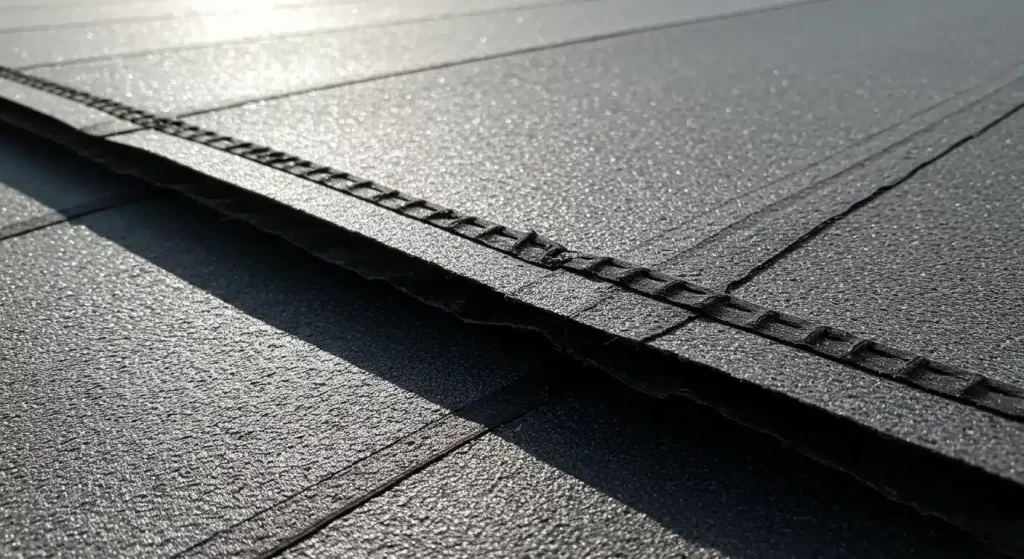
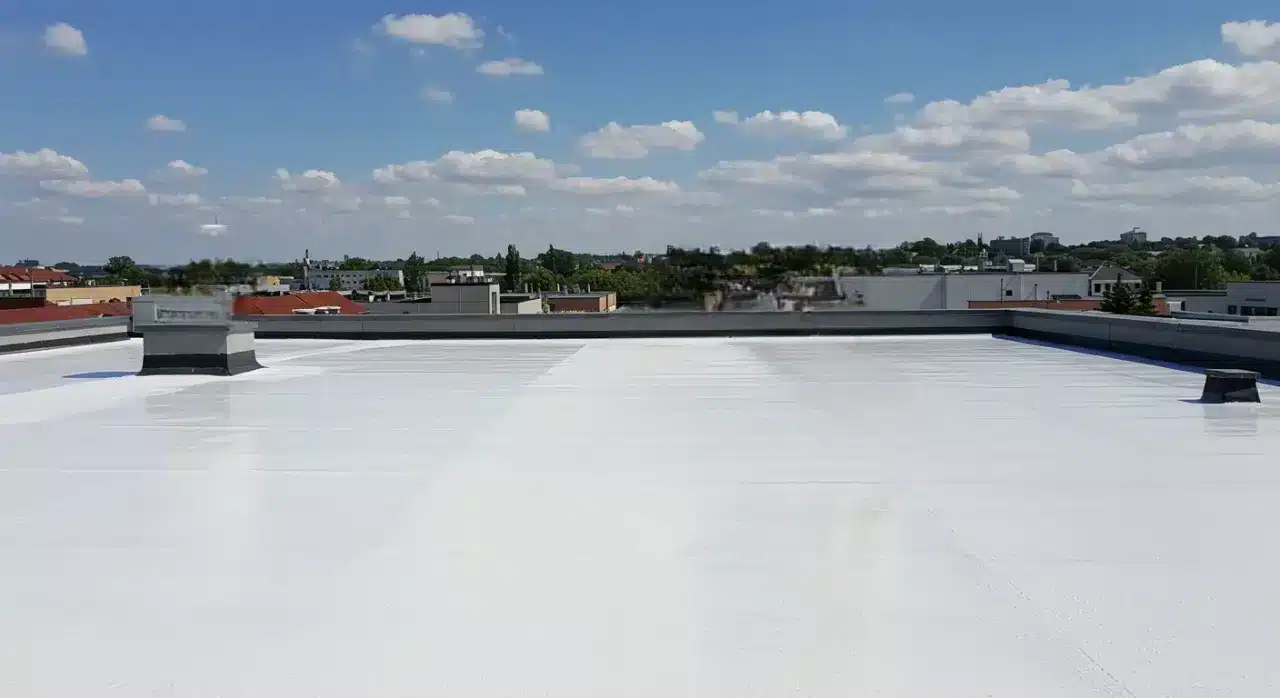
Membrane roofing refers to any roofing system that uses a continuous sheet of synthetic material as the primary waterproof barrier. Unlike traditional built-up roofs that layer hot asphalt and felt paper, a membrane roof is installed as large prefabricated sheets, sometimes spanning 50 feet wide or more, which are then seamed together at the joints.
The concept is straightforward: one continuous, waterproof layer covers the entire roof surface, with seams sealed by adhesives, tapes, or heat welding. This approach eliminates many of the weak points that plague older roofing methods, such as the alligator cracking and blistering that develop when asphalt breaks down under UV exposure.
According to Wikipedia’s flat roof reference, the National Roofing Contractors Association defines a low-slope roof as having a slope of 3 in 12 (1:4) or less. Membrane roofing is the go-to solution for these low-slope applications, which are extremely common on commercial buildings, warehouses, retail spaces, and multi-family structures throughout the Medford area.
Why Membrane Roofing Matters
A roof membrane is the first line of defense against water intrusion, and it operates in one of the most demanding environments on any building. It is continuously exposed to UV radiation, temperature swings, wind uplift, rain, snow, and foot traffic from maintenance workers. The quality of this single layer often determines whether your building stays dry or develops expensive structural problems.
The shift toward membrane systems over the past few decades is not a trend. It is a response to the failure rates of older roofing methods. Traditional built-up roofs rely on multiple layers of felt and hot asphalt, and when any one of those layers fails, water penetrates and soaks into the insulation and decking below. Membrane systems, by contrast, provide a single, factory-controlled layer of protection that is far more predictable in both performance and lifespan.
What Membrane Roofing Brings to the Table
- Single continuous sheet of synthetic material eliminates layered failure points
- Factory-manufactured quality control ensures consistent thickness and performance
- Designed specifically for low-slope and flat roof applications
- Handles UV exposure, temperature extremes, and ponding water far better than traditional materials
- Available in reflective options that reduce cooling costs during Medford’s hot summers
The Four Main Types of Membrane Roofing
Not all membrane roofing is the same. The material you choose affects everything from energy performance to how long the roof lasts and what kind of maintenance it needs. Below is a breakdown of the four primary membrane systems you will encounter.
EPDM (Ethylene Propylene Diene Monomer)
EPDM is a synthetic rubber membrane that has been the roofing industry’s workhorse for over 40 years. According to the EPDM Roofing Association, it has been the number one roofing choice of architects, roof consultants, and contractors for both new construction and replacement projects, based on market surveys from Building Design and Construction magazine and the National Roofing Contractors Association.
EPDM is available in black, gray, and white, and comes in widths ranging from 7.5 to 50 feet, with thicknesses of 45, 60, and 90 mils. It is a thermoset material, meaning once it is manufactured, it cannot be melted or reshaped. Seams are sealed using liquid adhesives or factory-applied pressure-sensitive tapes.
Key characteristics of EPDM:
- Extremely flexible and can stretch up to 300% without damage
- Withstands wide temperature fluctuations without becoming brittle
- Resists ozone and UV degradation exceptionally well
- Available with fleece backing for dramatically improved puncture and tear resistance
- White EPDM uses titanium dioxide to reflect UV rays and reduce cooling costs
- Fully adhered EPDM installations tend to deliver the longest service life
Drawbacks of EPDM:
- Black EPDM absorbs heat, which increases cooling loads in hot climates like Medford’s summers
- Adhesive-seamed joints are not as strong as heat-welded seams found on thermoplastic membranes
- Shrinkage can be a concern with non-reinforced membranes over time
Best for: Buildings where long-term durability is the priority, areas with extreme temperature swings, and roof designs where flexibility around penetrations and irregular shapes is needed.
Expert Tip: If you are considering EPDM in Medford’s climate, white EPDM or a ballasted system can significantly cut your cooling energy costs. Ballasted EPDM systems, where the membrane is held in place by river-washed stone, have been shown through studies at Oak Ridge National Laboratory to perform as effectively as white membrane roofs in reducing peak energy demand.
TPO (Thermoplastic Polyolefin)
TPO has become the single most popular type of commercial low-slope roof covering in the United States. Wikipedia's flat roof article notes that from 2007 to 2012, reported sales of TPO roofing products by all six major U.S. manufacturers quadrupled those of all other flat roofing materials combined.
TPO membranes consist of three layers: a TPO polymer base, a polyester reinforcement scrim in the middle, and a TPO polymer top ply. They are heat-fused at the factory into a single sheet. What makes TPO distinct is that it contains no plasticizers, which means it will not become brittle over time as plasticizer migration occurs (a known issue with PVC membranes).
Key characteristics of TPO:
- White TPO reflects 60-90% of sunlight, qualifying as a “cool roof.”
- Heat-welded seams are reported to be three to four times stronger than EPDM adhesive seams
- No plasticizers means better long-term flexibility retention
- Resistant to UV radiation, chemical exposure, and mold growth
- Available in 45-mil, 60-mil, and 80-mil thicknesses
Drawbacks of TPO:
- Relatively newer material with a shorter track record than EPDM (introduced in the early 1990s)
- Quality varies significantly between manufacturers
- Seam strength can be inconsistent if welding is not performed by trained installers
- Recyclability claims have been debated in the industry
Best for: New construction and re-roofing projects where energy efficiency is a priority, buildings in hot climates like southern Oregon, and owners looking for a balance of performance and cost.
PVC (Polyvinyl Chloride)
PVC membrane roofing is a thermoplastic system made from polyvinyl chloride blended with plasticizers, UV stabilizers, and reinforced with fiberglass or polyester scrims. Seams are heat-welded, creating a bond that is actually stronger than the membrane sheet itself.
As noted in Wikipedia's flat roof reference, while the surface of a black roof can experience a temperature increase of up to 50 degrees Celsius (90 degrees Fahrenheit) under full sun, a white reflective roof typically increases only 5 to 14 degrees Celsius (9 to 25 degrees Fahrenheit). Even black PVC runs roughly 40 degrees cooler than black asphalt or EPDM roofs.
Key characteristics of PVC:
- Excellent chemical and grease resistance, making it ideal for restaurants and manufacturing
- Heat-welded seams create a permanent, watertight bond
- Inherently fire-resistant due to the chlorine content in the material
- Highly reflective white surface delivers strong energy savings
- Available in a range of thicknesses, with thicker membranes maintaining flexibility longer
Drawbacks of PVC:
- Subject to plasticizer migration over time, which can cause brittleness
- Environmental concerns around the chlorine content and manufacturing process
- Generally higher material cost than TPO
- Can be sensitive to certain petroleum-based products
Best for: Buildings with grease or chemical exposure (restaurants, manufacturing), roofs where fire resistance is critical, and climates where maximum reflectivity is needed.
Modified Bitumen
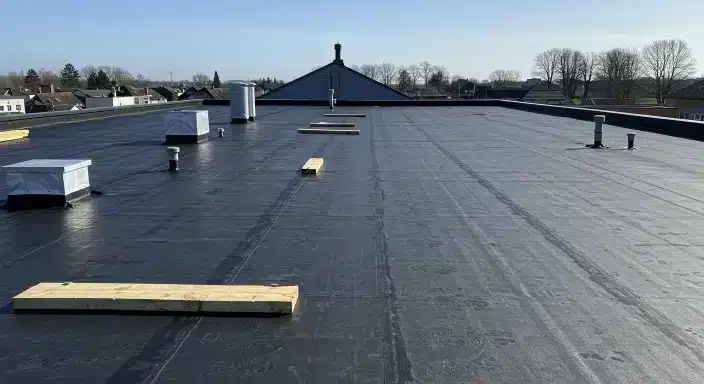
Modified bitumen is a hybrid system that bridges the gap between traditional built-up roofing and modern single-ply membranes. It consists of asphalt modified with either APP (atactic polypropylene) or SBS (styrene-butadiene-styrene) rubber polymers, reinforced with polyester or fiberglass, and surfaced with mineral granules or a smooth finish.
Key characteristics of modified bitumen:
- Two application types: torch-applied (heat-welded using an open flame) or cold-applied (adhesive-based)
- APP-modified sheets offer excellent UV resistance
- SBS-modified sheets provide rubber-like flexibility in cold temperatures
- Multi-ply redundancy gives built-in protection if the top layer is compromised
- Granule surface provides good foot traction and UV protection
Drawbacks of modified bitumen:
- Torch application presents a fire hazard and is banned in some municipalities
- More labor-intensive to install than single-ply membranes
- Heavier system overall, which may require structural evaluation
- Shorter typical lifespan than single-ply alternatives (20-30 years)
Best for: Roof replacement projects where the existing structure cannot support a complete tear-off, buildings where foot traffic is expected on the roof, and owners who prefer the redundancy of a multi-ply system.
Membrane Type Comparison
The table below gives you a quick side-by-side look at how the main membrane types stack up against each other on the factors that matter most.
| Feature | EPDM | TPO | PVC | Modified Bitumen |
|---|---|---|---|---|
| Material Type | Thermoset rubber | Thermoplastic | Thermoplastic | Asphalt-polymer hybrid |
| Seam Method | Adhesive or tape | Heat-welded | Heat-welded | Heat-welded or cold-adhered |
| Typical Lifespan | 25-50 years | 15-30 years | 20-30 years | 20-30 years |
| Reflectivity | Low (black) / High (white) | High (white) | High (white) | Moderate |
| Flexibility | Excellent | Very good | Very good | Good (SBS) / Fair (APP) |
| Chemical Resistance | Fair | Good | Excellent | Fair |
| Energy Efficiency | Low (black) / High (white) | High | High | Moderate |
| Installation Cost | Low to moderate | Low to moderate | Moderate to high | Moderate |
| Fire Resistance | Fair | Good | Excellent | Good (with proper surfacing) |
How Climate Affects Membrane Performance in Medford, OR
Medford sits in the Rogue Valley of southern Oregon, where the climate presents a specific set of challenges for any roofing system. Summer highs routinely exceed 95 degrees, with some days pushing well past 100. Winters bring freezing temperatures, occasional snow, and prolonged periods of overcast, wet weather. The UV index during summer months is among the highest in the state.
These conditions influence membrane selection in several important ways.
Heat and UV exposure. During peak summer, a black EPDM roof can absorb enormous amounts of solar energy, transferring heat into the building and accelerating material aging. A white TPO or PVC membrane reflects the majority of that solar radiation, reducing both cooling costs and thermal stress on the material itself. The U.S. Department of Energy’s Cool Roofs guide notes that conventional dark roofs can reach 150 degrees Fahrenheit or more on a sunny summer afternoon, while a reflective roof under the same conditions can stay more than 50 degrees cooler.
Freeze-thaw cycling. Medford’s winters bring repeated freezing and thawing, which puts stress on membrane seams and flashings. Materials that remain flexible at low temperatures handle this cycling better. SBS-modified bitumen and EPDM both perform well in cold conditions, while some TPO formulations can become less flexible in sub-freezing temperatures.
Seasonal rainfall. The wet season brings sustained moisture exposure. Membranes must be able to withstand prolonged contact with water without degradation. All four major membrane types handle this well, but proper drainage design and regular maintenance of gutters and scuppers are essential to prevent ponding.
Expert Tip: In Medford’s mixed climate, white membranes (TPO or PVC) tend to offer the best overall value. The summer cooling savings offset any modest winter heating penalty, and the reduced thermal stress helps extend the membrane’s service life. However, if your building has significant shading from trees or adjacent structures, the energy savings from reflectivity diminish, and EPDM’s proven longevity becomes a stronger argument.
How Membrane Roofing Gets Installed
Understanding the installation process helps you evaluate quotes, ask the right questions, and recognize quality work. While every project is unique, membrane installations follow a general sequence.
Step 1: Roof Deck Inspection and Preparation
Before any membrane material goes on the roof, the existing deck must be evaluated. Our crew inspects the structural deck and looks for rot, water damage, and structural issues. If we are replacing an existing roof, the old material is removed down to the deck. Any damaged plywood, OSB, or metal decking is replaced.
The deck surface must be clean, dry, smooth, and free of debris. Fasteners from the old roof are removed or properly seated. Any irregularities are repaired because even small bumps or protrusions can telegraph through the membrane over time.
Step 2: Vapor Barrier and Insulation Installation
A vapor barrier may be installed depending on the building’s use and climate zone. This prevents moisture from inside the building from migrating into the roof assembly and condensing, which can saturate insulation and destroy its R-value.
Rigid insulation boards (typically polyiso, EPS, or XPS) are then laid over the vapor barrier and mechanically fastened or adhered to the deck. The thickness of insulation directly affects the building’s energy efficiency, and local energy codes dictate minimum requirements. In Medford, where both heating and cooling are needed, getting the insulation right is just as important as choosing the right membrane.
Expert Tip: Do not underestimate the insulation layer. The membrane keeps water out, but the insulation determines how much energy you lose through the roof. We frequently see buildings where upgrading the insulation during a re-roof project pays for itself in energy savings within a few years.
Step 3: Membrane Roll-Out and Attachment
The membrane is rolled out across the prepared insulation. Depending on the system chosen, it is attached in one of three ways:
Fully adhered. The membrane is bonded directly to the insulation using a water-based or solvent-based adhesive. This method provides the strongest attachment and the smoothest appearance. It is ideal for smaller roofs, roofs with complex geometries, and installations where wind uplift is a concern. According to the EPDM Roofing Association’s standard attributes documentation, fully adhered systems have become the system of choice for roof replacement applications in many areas.
Mechanically attached. The membrane is fastened to the deck through the insulation using screws and stress plates, or attached in the side laps. This method is lighter, faster, and less expensive than fully adhered installation. It works well on larger, open roof areas.
Ballasted. The membrane is loose-laid over the insulation and held in place by smooth, river-washed stone or concrete pavers. Ballasted systems account for approximately 35 percent of EPDM installations and are the easiest and fastest of all methods to install. They require the building structure to support the added weight of ballast, typically 10-25 pounds per square foot.
Step 4: Seaming and Detailing
Seams are where two membrane sheets meet, and they are the most critical part of the installation. For thermoset membranes like EPDM, seams are sealed with liquid adhesives or factory-applied pressure-sensitive tapes. For thermoplastic membranes like TPO and PVC, seams are heat-welded using specialized equipment that fuses the two sheets into a single continuous piece.
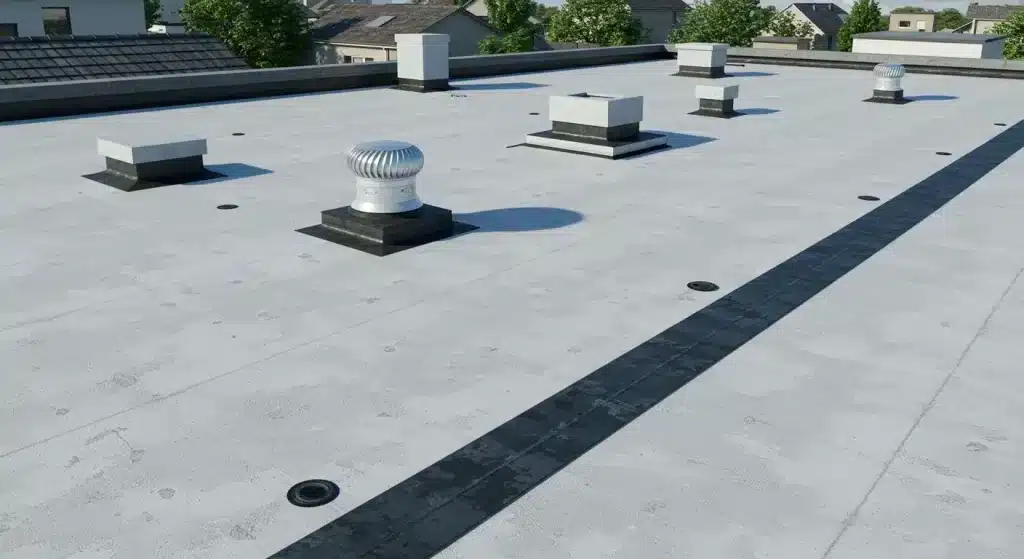
Detail work around roof penetrations, vents, pipes, skylights, and edges is where experienced installers separate themselves from the rest. Each penetration gets custom flashing, and every edge gets termination bars with sealant. According to Wikipedia's flat roof reference, 90 percent of all roof leaks occur at flashings and penetrations, not in the field of the membrane itself.
Step 5: Final Inspection and Quality Assurance
Once the membrane is installed, our team walks the entire roof to inspect seams, flashings, and edge details. We check for wrinkles, fishmouths, blisters, and any voids in the adhesive. Flashing details are checked for full contact, and all penetrations are verified. Many membrane manufacturers require photo documentation of the installation process for warranty validation.
The Installation Process
- Proper deck preparation and insulation installation are just as important as the membrane itself
- The three main attachment methods (fully adhered, mechanically attached, ballasted) each have distinct advantages depending on the building
- Seaming quality determines whether your roof stays watertight
- Flashing and detailing around penetrations are where most leaks originate
- Final inspection and photo documentation protect your warranty investment
Membrane Roof Lifespan and What Affects It
One of the most important questions building owners ask is how long a membrane roof will last. The answer depends on several factors, but the data gives us clear benchmarks.
EPDM Longevity Data
The EPDM Roofing Association recently completed a comprehensive review of membrane service life. Based on field evidence, laboratory findings, and practitioner input from a 2025 survey of 569 roofing professionals, the EPDM Roofing Association has announced that properly designed, installed, and maintained EPDM roof membranes have an expected service life of 38 years. Many survey respondents reported encountering EPDM roofs still performing at 40, 45, and even 50 years of age.
Independent studies of in-situ aged EPDM membranes in North America and Europe found that membranes with 17 to 32 years of service remained watertight and still met key physical-property requirements of newer material.
Factors That Influence Service Life
Membrane thickness. Thicker membranes generally last longer. A 60-mil EPDM membrane has more material to resist weathering than a 45-mil membrane. Thicker PVC membranes have a larger reservoir of plasticizer to maintain flexibility.
Installation quality. Even the best membrane will fail prematurely if it is poorly installed. Proper attachment, correct seam techniques, and thorough detailing around penetrations matter enormously.
Maintenance routine. Regular inspections and prompt repairs are the single largest controllable factor in roof lifespan. A well-maintained 20-year membrane can outlast a neglected 30-year membrane.
Climate exposure. UV radiation, temperature extremes, and chemical exposure all accelerate aging. In Medford’s high-UV environment, white or reflective membranes tend to age more slowly than black ones.
Roof design. Proper drainage slope, adequate insulation, and compatible accessories all contribute to longer service life. Ponding water, even on a quality membrane, accelerates deterioration.
Expert Tip: Ask your installer about warranty terms and what they actually cover. Many membrane warranties run 20 to 30 years, but that warranty only remains valid if the installation follows the manufacturer’s specifications exactly. Keep records of all maintenance and repairs, as warranty claims often require proof of ongoing care.
Maintenance: Protecting Your Membrane Investment
Maintenance is not optional. It is the difference between a roof that lasts 20 years and one that lasts 40. A consistent maintenance routine catches small problems before they become expensive ones.
Biannual Inspections
Every roof should be inspected at least twice a year, ideally in spring and fall. After major storms or severe weather events, an additional inspection is warranted. During these inspections, look for:
- Membrane damage such as cuts, punctures, tears, or blistering
- Seam separation or adhesive failure
- Flashing deterioration around penetrations, edges, and wall-to-roof transitions
- Ponding water that persists for more than 48 hours
- Debris accumulation in drains, gutters, and scuppers
- Signs of biological growth (moss, algae, mold)
- Damage from foot traffic or equipment installations
Drainage Maintenance
Clogged drains are one of the most common and preventable causes of flat roof failure. When drains are blocked by leaves, gravel, or debris, water ponds on the roof surface. The deeper the water, the greater the hydrostatic pressure pushing against seams and flashings. In freezing temperatures, ponded water expands as it turns to ice, which can physically break the membrane surface.
Keep all drains, gutters, and scuppers clear of debris year-round. After the fall leaf drop and before the winter rainy season are critical times for this maintenance in Medford.
Repair Protocols
When damage is found, repairs should be made promptly. For EPDM, repairs typically involve cleaning the damaged area, applying splice adhesive or seam tape, and allowing proper curing time. For TPO and PVC, damaged sections can be cut out and replacement material heat-welded into place. For modified bitumen, repairs use compatible mastic and reinforcement mesh.
The most important rule of membrane repair is to use only materials and methods approved by the membrane manufacturer. Mixing incompatible adhesives or sealants can cause more damage than the original problem.
Common Problems and How to Address Them
Even well-installed membrane roofs can develop issues over time. Knowing what to look for helps you catch problems early.
Ponding Water
Water that sits on a roof for more than 48 hours after rainfall is considered ponding. While most membrane materials can withstand temporary ponding, chronic ponding accelerates membrane degradation and can promote biological growth. It also adds dead load weight that the building structure may not have been designed to carry.
Solutions include adding tapered insulation to improve drainage slope, installing additional roof drains or scuppers, or in some cases using automatic siphon systems to evacuate standing water.
Seam Failure
Seam failure is one of the most common sources of membrane roof leaks. Adhesive-seamed EPDM joints can weaken over time as the adhesive ages, especially if the original installation was not performed under optimal temperature and humidity conditions. Heat-welded seams on TPO and PVC are generally stronger but can fail if the welding temperature or speed was incorrect during installation.
Regular seam inspection and testing can identify weak spots before they become leaks. Infrared thermography is sometimes used to detect moisture infiltration at seam areas.
Flashing Deterioration
Flashings at roof edges, around penetrations, and at wall-to-roof transitions are the most vulnerable parts of any roofing system. The sharp bends and irregular shapes at these locations put stress on the membrane material, and the sealant used to terminate flashings degrades over time.
Inspecting flashings during routine maintenance and re-sealing them before the sealant fails is far less expensive than replacing water-damaged insulation and decking.
Blistering
Blisters form when moisture gets trapped between the membrane and the substrate, then expands when heated by the sun. Small blisters may not be active leaks, but they indicate that water has penetrated the system at some point. Blisters should be investigated, cut open, dried out, and properly repaired rather than ignored.
Energy Efficiency and Cool Roof Benefits
Membrane roofing offers significant energy efficiency advantages, especially for buildings in climates like Medford’s where summer cooling demands are substantial.
White and light-colored membrane options, particularly TPO and PVC, deliver high solar reflectance. According to the U.S. Department of Energy's Cool Roofs page, white roofing products reflect about 60 to 90 percent of sunlight, while conventional dark roofs absorb the vast majority of solar radiation. The DOE also notes that cool roofs can reduce peak electricity demand and help prevent power outages by decreasing the overall load on the electrical grid during the hottest days.
For Medford building owners, this translates to real savings on air conditioning costs during the long summer season. A reflective membrane roof can reduce the surface temperature by more than 50 degrees compared to a conventional dark roof, which means less heat conducts into the building and cooling equipment does not have to work as hard.
There is a tradeoff to consider. Cool roofs can incur a winter heating penalty by reflecting solar energy that would otherwise help warm the building. In Medford’s mixed climate, the summer cooling savings generally outweigh the winter heating penalty, but the exact balance depends on your building’s insulation levels, heating system efficiency, and occupancy patterns.
Expert Tip: If your building has well-insulated attic spaces or a high-quality roof insulation system, the winter heating penalty from a cool roof is minimal. The better your insulation, the more you benefit from reflective roofing year-round, because insulation prevents both heat gain in summer and heat loss in winter regardless of the roof surface color.
Putting Your Membrane Roofing Strategy into Action
Choosing and installing a membrane roof is one of the most important infrastructure decisions you will make for your building. The right system, properly installed and consistently maintained, can protect your investment for decades. The wrong choice, or a poorly executed installation, can lead to chronic leaks, expensive structural damage, and premature replacement.
Start by understanding your building’s specific needs: its structural capacity, drainage patterns, insulation levels, and how it is used. Then match those needs against the strengths and weaknesses of each membrane type. Prioritize installation quality over material cost, because even the best membrane will fail if the crew installing it takes shortcuts.
Use this guide as a reference as you evaluate options and talk with roofing professionals. The more informed you are, the better decisions you will make.
Need Expert Guidance?
Deciding on the right membrane roofing system for your building in Medford takes careful evaluation of your roof’s condition, your building’s needs, and your long-term goals. Our team at All Foam & Insulation, LLC brings years of hands-on experience with commercial and flat roofing projects across southern Oregon, and we are happy to walk through your options in person.
Give us a call at (541) 826-9600 or send an email to [email protected] to schedule a consultation. We will assess your roof, discuss the membrane types that make the most sense for your situation, and help you develop a plan that protects your building for the long haul.
Frequently Asked Questions About Membrane Roofing in Medford, OR
What is the best membrane type for a commercial building in Medford?
White TPO and PVC are popular choices because their reflective surfaces handle Medford’s intense summer sun well. EPDM is also an excellent option, especially white EPDM, which combines proven longevity with reflectivity. The best choice depends on your building’s specific use, budget, and existing structure.
How long does a membrane roof last?
EPDM membranes have a documented expected service life of up to 38 years when properly installed and maintained. TPO and PVC membranes typically last 20 to 30 years. Modified bitumen systems generally provide 20 to 30 years of service. Actual lifespan depends heavily on installation quality and ongoing maintenance.
Can a membrane roof be installed over an existing roof?
In many cases, yes. A membrane roof can be installed as a recover system over an existing single layer of roofing, provided the existing roof is in acceptable condition and the building structure can support the additional load. Local codes typically limit roofing to two layers total. A full tear-off is recommended if the existing roof has moisture damage or more than one existing layer.
How often should a membrane roof be inspected?
At minimum, twice per year in spring and fall. Additional inspections should be scheduled after major storms, severe wind events, or any work performed on the roof by other trades. Regular inspections catch small problems before they become leaks that damage insulation and decking.
Does membrane roofing work on residential buildings?
Absolutely. While membrane roofing is most common on commercial and industrial buildings, it is also used on residential flat or low-slope roofs, including additions, porches, garages, and modern flat-roof home designs. EPDM is particularly popular for residential applications due to its affordability and ease of installation.
Can solar panels be installed on a membrane roof?
Yes. Membrane roofs are compatible with solar panel installations, and some attachment systems are specifically designed for single-ply membranes. Ballasted solar racks that sit on the membrane without penetrating it are a common approach. The membrane should be evaluated for its remaining service life before investing in a solar installation, since you want the roof to last as long as the solar panels.
Sources
- Wikipedia – Flat Roof – Comprehensive reference on flat roof types, construction methods, membrane materials (EPDM, TPO, PVC, modified bitumen), installation methods, maintenance, and cool roof performance
- EPDM Roofing Association – What is EPDM?) – Industry association overview of EPDM membrane properties, history, and market position in low-slope commercial roofing
- EPDM Roofing Association – Longevity and Service Life – 2025 service life research with survey of 569 roofing professionals and 38-year expected service life announcement
- EPDM Roofing Association – Standard Attributes and Installation Methods – Detailed breakdown of ballasted, mechanically attached, and fully adhered EPDM installation systems
- U.S. Department of Energy – Cool Roofs – Federal guide on cool roof benefits, energy savings potential, and reflectivity performance data for low-slope membrane products