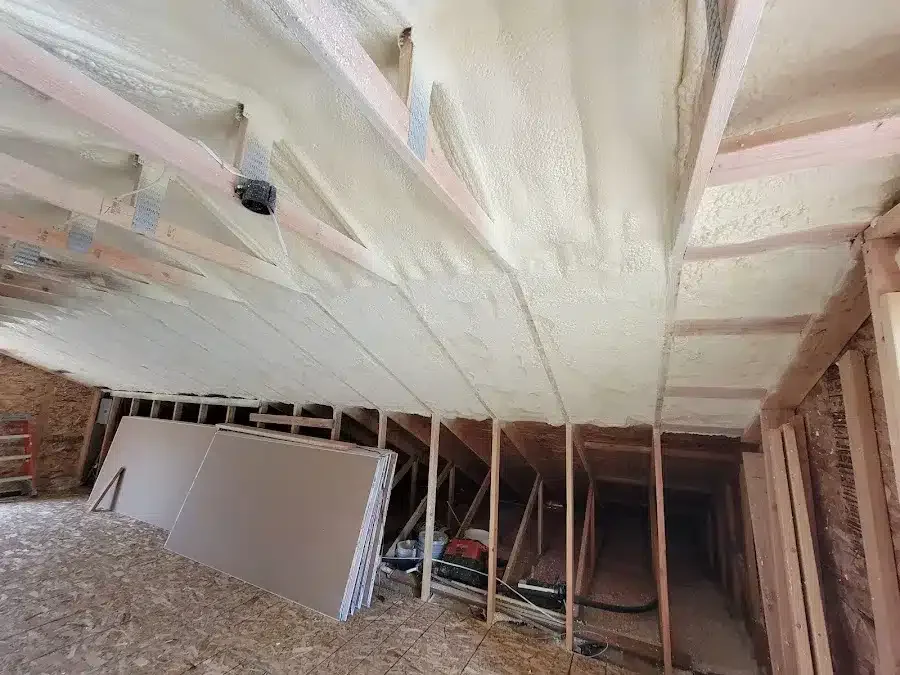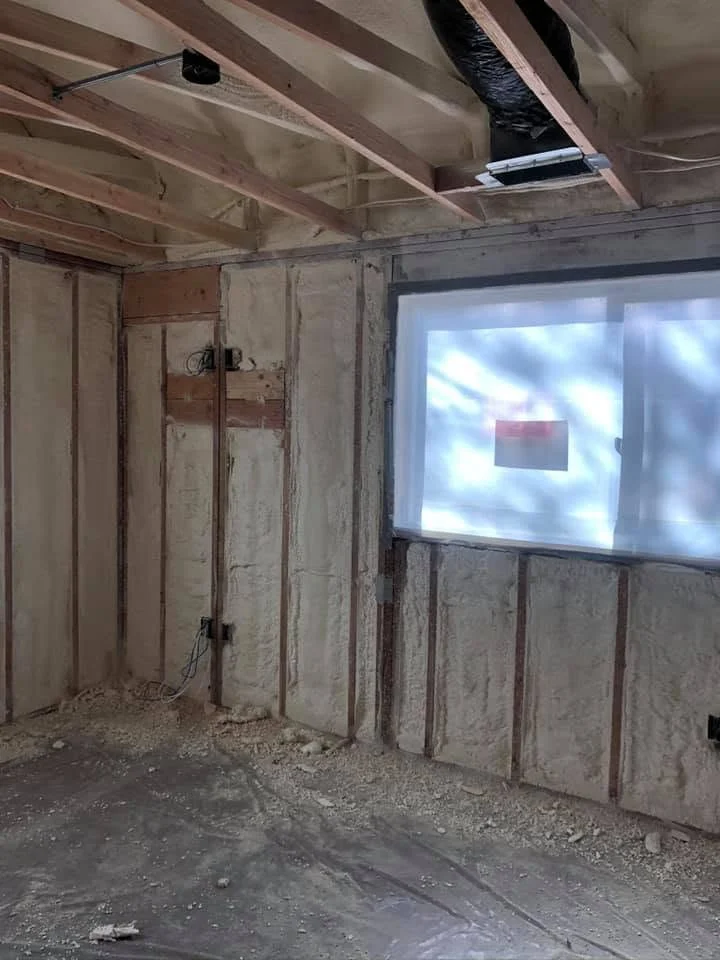
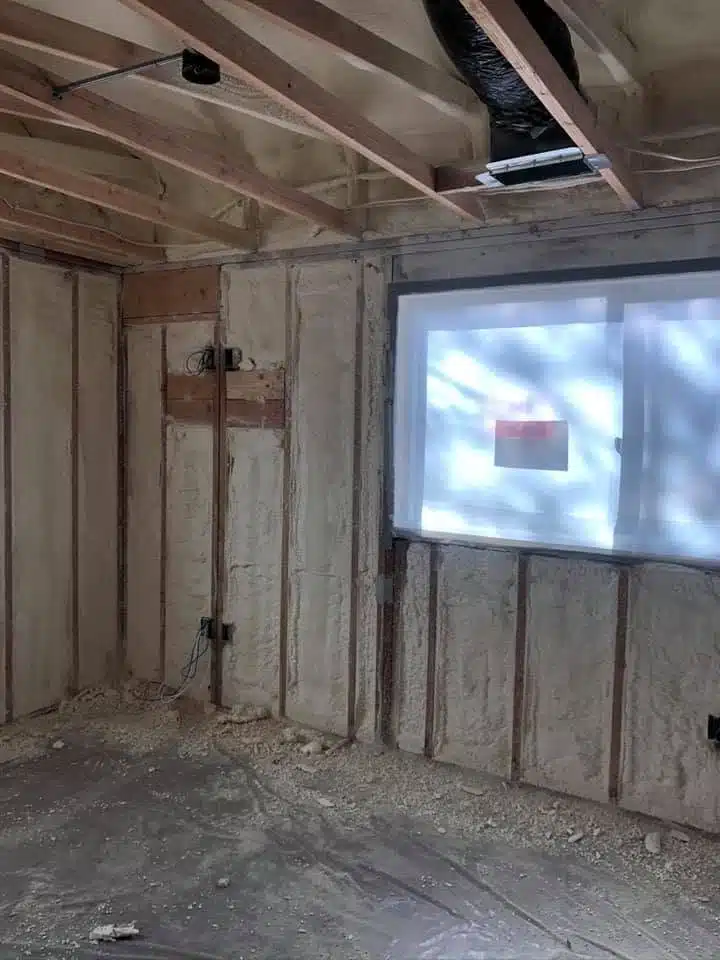
Drafty walls and attics in Medford, OR homes are most effectively addressed by installing closed-cell spray polyurethane foam, which delivers an R-value of approximately 6.5 per inch, functions simultaneously as an air barrier, vapor retarder, and thermal control layer, and is specifically recommended for cold and marine climates where condensation control matters. Medford sits in IECC Climate Zone 4C, a marine-influenced region where winter temperatures regularly drop below freezing, making both the air-sealing and vapor-retarding properties of closed-cell foam essential for lasting comfort and structural protection.
TLDR / Key Takeaways
- Closed-cell spray foam delivers roughly R-6.5 per inch, the highest per-inch thermal resistance among common residential insulation materials.
- In IECC Climate Zone 4C (where Medford falls), attics need R-60 and walls need R-20 cavity insulation plus R-5 continuous insulation to meet current energy code.
- Closed-cell foam is the only single product that provides water control, air control, vapor control, and thermal control in one application.
- EPA estimates that air sealing combined with insulation upgrades can save homeowners an average of 15% on heating and cooling costs nationally, with savings in marine climate zones reaching 20% on heating and cooling alone.
- For unvented conditioned attics in Climate Zone 5 and higher, Building Science Corporation recommends only high-density closed-cell spray foam applied directly to the underside of the roof deck.
- Field evaluations of in-service roofs with spray foam insulation have shown moisture contents well within the safe range for wood sheathing, confirming long-term durability.
- Hybrid approaches, combining closed-cell foam as a condensation control layer with fiberglass or cellulose for total R-value, offer cost-effective solutions for wall cavities and attics.
Why Medford Homes Are Vulnerable to Drafts and Energy Loss
Medford sits in the Rogue Valley of southern Oregon, classified under IECC Climate Zone 4C. This marine zone brings wet, cool winters with regular freezing temperatures and significant precipitation. Older homes in the area, especially those built before modern energy codes, commonly suffer from inadequate wall insulation, poorly sealed attic floors, and vented attics that allow conditioned air to escape through dozens of penetration points.
According to the Department of Energy, heat flows from warmer living spaces directly to adjacent unconditioned attics, garages, and the outdoors during winter. In a typical older Medford home, that heat loss happens through wall cavities filled with degraded fiberglass, through gaps around recessed lights and plumbing vents in the attic floor, and through rim joists in basements and crawlspaces.
The Rogue Valley’s winter conditions make these air leaks especially problematic. Cold outdoor air infiltrating through wall penetrations and attic bypasses creates noticeable drafts, uneven room temperatures, and forces heating systems to work harder than necessary. Moisture from indoor activities like cooking and showering can also pass through these leaks into attic spaces and wall cavities, where it condenses on cold surfaces and risks causing mold growth and wood rot.
What Makes Closed-Cell Spray Foam Different
Not all insulation materials address air leakage and moisture movement. Closed-cell spray polyurethane foam stands apart because of its physical structure and density. At approximately 2 lb/ft3, closed-cell foam has a significantly higher density than open-cell alternatives, which typically weigh around 0.5 lb/ft3.
As documented by Building Science Corporation, closed-cell spray foam is the only insulation product currently available that can perform all four principal control layer functions of a building envelope: water control, air control, vapor control, and thermal control. No other single material accomplishes this.
Insulation Type Comparison
| Insulation Type | R-Value per Inch | Air Barrier | Vapor Barrier | Best Application |
|---|---|---|---|---|
| Closed-Cell Spray Foam | ~6.5 | Yes | Yes (Class II at 1.5″) | Walls, attics, rim joists, crawlspaces |
| Open-Cell Spray Foam | ~3.5 | Yes | No | Interior walls, sound control |
| Fiberglass Batts | ~3.2 | No | No | Standard wall cavities (with air sealing) |
| Blown Cellulose | ~3.5 | No | No | Attic floors, enclosed wall cavities |
| Rigid Foam Board (XPS) | ~5.0 | Depends on installation | Yes | Continuous exterior insulation |
| Mineral Wool Batts | ~3.7 | No | No | Fire-rated wall assemblies |
The vapor permeance of closed-cell foam is approximately 3 perms per inch, which means at 1.5 inches of thickness it qualifies as a Class II vapor retarder under the International Residential Code. This is a practical advantage in Medford’s Climate Zone 4C, where controlling inward vapor drive during cold, wet winters helps prevent condensation within wall and roof assemblies.
How Closed-Cell Foam Fixes Drafty Attics
Unvented Conditioned Attic Approach
For homes with HVAC equipment or ductwork located in the attic space, converting to an unvented conditioned attic is one of the most effective upgrades available. Instead of insulating the attic floor and attempting to seal hundreds of individual penetration points, closed-cell foam is sprayed directly to the underside of the roof deck. This moves the insulation, air barrier, and thermal boundary to the roof plane, bringing ductwork and mechanical systems into the conditioned envelope.
Building Science Corporation’s Residential Spray Foam Guide specifies that in IECC Climate Zones 5 and higher, only high-density closed-cell spray foam should be used directly against roof sheathing for unvented attic assemblies. While Medford falls in Zone 4C, the marine designation and cold winter temperatures make the closed-cell recommendation equally appropriate.
A hybrid approach is also common and effective. In this method, a layer of closed-cell foam is first applied to the roof deck to provide the required condensation control and air barrier, then fiberglass or cellulose is installed over it to reach the full target R-value. This reduces material costs while maintaining the performance characteristics needed for durability.
Vented Attic Air Sealing
For homes where a vented attic will remain, the priority shifts to air sealing the ceiling plane. The ENERGY STAR Attic Air Sealing Project guide identifies the most common and significant air leak locations:
- Behind and under knee walls
- Attic hatches and pull-down stairs
- Wiring holes and electrical penetrations
- Plumbing vent stacks and pipe chases
- Dropped soffits open to the attic
- Recessed light housings
- Furnace flue and duct chaseways
Closed-cell foam is ideal for sealing these penetrations because it expands to fill irregular gaps, adheres to framing and sheathing, and creates a permanent air seal that will not degrade over time. Once the major air leaks are sealed, the attic floor can be insulated with blown cellulose or fiberglass to meet the R-60 recommendation for Climate Zone 4C.
How Closed-Cell Foam Fixes Drafty Walls
Most existing Medford homes have 2×4 wall cavities originally insulated with fiberglass batts. Over decades, these batts can settle, compress, or be displaced by electrical and plumbing modifications, creating voids where air moves freely through the wall. The result is cold spots on interior walls, particularly near windows and exterior corners.
Closed-cell spray foam injected into existing wall cavities through small holes drilled through the exterior or interior can fill these voids completely. According to the Building Science Corporation guide, as long as spray foam is sprayed to the minimum depth classified as an air-impermeable insulation, the foam does not need to completely fill the cavity to be effective. This means a 1-inch to 1.5-inch layer of closed-cell foam against the sheathing can serve as the air and vapor control layer, while the remaining cavity depth provides the balance of thermal resistance.
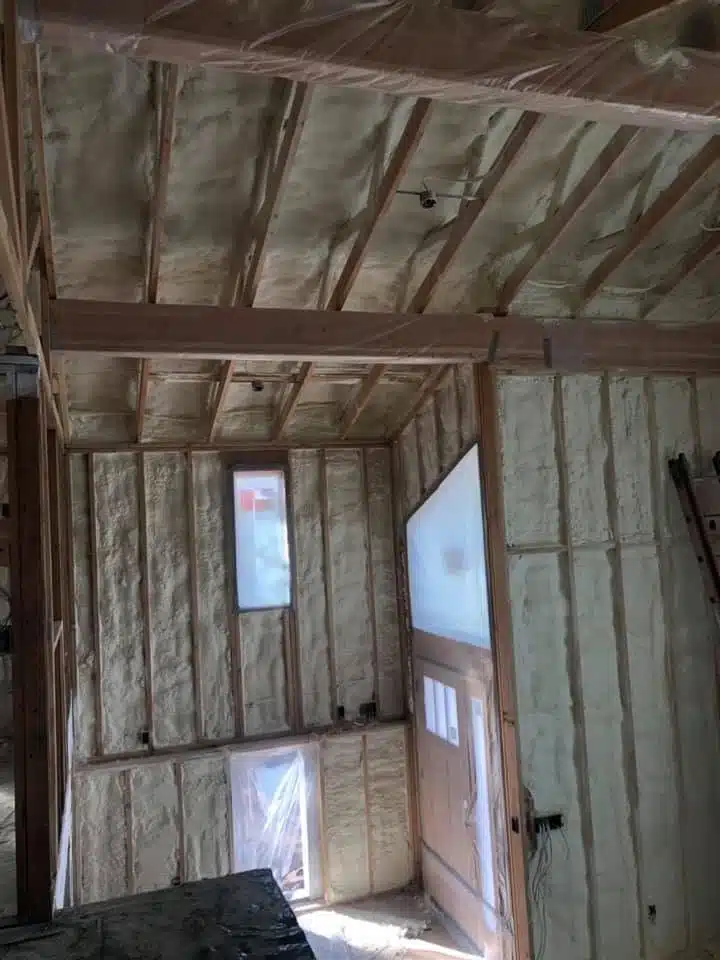
For retrofit wall applications, a hybrid wall approach is often used: closed-cell foam sprayed against the interior face of the exterior sheathing acts as the air barrier and condensation control layer, while fiberglass or cellulose fills the remainder of the cavity for total R-value.
Climate Zone Requirements for Medford
The DOE recommends specific R-values based on climate zone classification. For Climate Zone 4C (Marine), the minimum recommended insulation levels are:
| Building Assembly | Minimum R-Value (New Construction) | Minimum R-Value (Existing with Upgrade) |
|---|---|---|
| Uninsulated Attic | R-60 | R-49 |
| Existing Attic (3-4 inches present) | R-49 | R-38 |
| Uninsulated Wood-Frame Wall | R-20 + R-5 CI or R-13 + R-10 CI | R-20 + R-5 CI or R-13 + R-10 CI |
| Floor Over Unconditioned Space | R-30 | R-30 |
Closed-cell foam’s high R-value per inch makes it practical to achieve these targets even in shallow wall cavities and complex framing configurations. A 2×4 stud cavity (3.5 inches) filled with closed-cell foam delivers approximately R-22 to R-23, exceeding the code minimum for cavity insulation in a single application.
Real-World Scenarios in Medford
| Scenario | Home Type | Problem | Solution | Outcome |
|---|---|---|---|---|
| 1970s ranch with ductwork in vented attic | Single-story, 1,600 sq ft | Cold rooms, high heating bills, ice dams | Closed-cell foam on roof deck, converted to conditioned attic | Eliminated ice dams, reduced heating load, even temperatures |
| 1950s cottage with 2×4 walls and no wall insulation | 1,200 sq ft, single-story | Drafty walls, cold exterior corners, visible dust streaks at outlets | Closed-cell foam injected into wall cavities, 1.5″ minimum | Air infiltration reduced, warm wall surfaces, no more condensation on windows |
| 1990s two-story with upgraded attic fiberglass but no air sealing | 2,400 sq ft, two-story | Unpredictable temperatures between floors, dust accumulation | Closed-cell foam sealed all attic floor penetrations, then topped with blown cellulose | Consistent temperatures, dust reduced, heating system cycles less frequently |
| 1960s home with vented crawlspace and cold floors above | 1,800 sq ft, raised foundation | Cold floors, musty smell, high moisture in crawlspace | Closed-cell foam on floor joists and rim joist areas, sealed all penetrations | Warm floors, moisture controlled, crawlspace encapsulated against ground moisture |
| 1985 split-level with cantilevered floor overhangs | 2,000 sq ft, split-level | Freezing cold floors in overhang bays, visible mold on ceiling below | Closed-cell foam sprayed into cantilevered bays, sealing rim joist connection | Cold floors eliminated, mold risk addressed, structural integrity maintained |
Factors That Affect Closed-Cell Foam Performance
Several variables determine how well closed-cell insulation performs in any given Medford home:
Foam Thickness. The R-value scales linearly with thickness. Meeting or exceeding the minimum thickness for air impermeability and Class II vapor retarder classification is essential. In most wall applications, 1.5 to 2 inches of closed-cell foam provides both the condensation control and the air barrier properties needed.
Installation Quality. Closed-cell foam must be applied at the correct temperature, with proper substrate preparation, and at the right spray angle and pass thickness. Foam applied to wet surfaces, including damp OSB or plywood, can fail to adhere properly and create delamination risks. Building Science Corporation field investigations found that one full-roof failure was traced to foam installed on wet OSB where adhesion was compromised.
Climate Zone Classification. Medford’s 4C marine designation means moisture control is a priority alongside thermal performance. The marine influence brings seasonal wetness that makes the vapor-retarding properties of closed-cell foam particularly valuable.
Building Age and Construction Type. Older homes with balloon framing, knob-and-tube wiring, or vermiculite insulation require additional assessment before foam installation. Knob-and-tube wiring, common in pre-1930s homes, poses a fire hazard if spray foam makes contact.
Moisture Management. While closed-cell foam controls vapor diffusion, bulk water from roof leaks must still be managed through proper water control layers. Unvented roof assemblies require attention to moisture removal, typically through slight pressurization from the living space below or dedicated exhaust ventilation.
Actionable Steps for a Successful Installation
- Conduct a thorough inspection of the attic and walls before any insulation work. Identify active roof leaks, knob-and-tube wiring, mold growth, or wet insulation. Address these problems first, as the Building Science Corporation recommends that health and safety issues take priority over energy efficiency upgrades.
- Air seal the attic floor comprehensively if planning a vented attic approach. Use closed-cell foam at all penetration points including top plates, around chimneys (with proper metal flashing and high-temperature sealant), plumbing stacks, electrical wire runs, and dropped soffits.
- For unvented conditioned attics, apply closed-cell foam directly to the roof deck at a thickness that meets both the R-value target and the minimum depth for condensation control. In Climate Zone 4C, follow the IRC Table R806.5 requirements for minimum foam thickness based on framing type.
- Seal rim joist and cantilevered floor areas with closed-cell foam. These locations are often the worst air leak points in a home and are difficult to insulate effectively with any material other than spray foam.
- Verify mechanical ventilation is in place after air sealing. EPA’s ENERGY STAR program recommends testing for radon and verifying that combustion appliances draft properly before and after sealing work. Reducing air leakage may require adding mechanical ventilation to maintain indoor air quality.
- Plan for moisture removal in unvented attic assemblies. The best practice involves exhausting air from the attic peak through a ducted fan, with matching supply air from the outdoors to the HVAC return. This slight negative pressure in the attic draws conditioned air from the house below while balanced ventilation maintains whole-house pressure.
Expected Energy Savings
According to the ENERGY STAR methodology for estimated energy savings, homeowners in Climate Zone 4C can expect approximately 13% savings on total energy bills and 20% savings on heating and cooling costs when combining air sealing with insulation upgrades to meet current energy code requirements. Savings estimates are higher in colder zones due to greater heating demands and longer heating seasons.
In the Rogue Valley, where winters are cold and wet and summers can bring significant heat, these savings translate to meaningful reductions in both heating and cooling expenses over the lifetime of the insulation.
Get Started with All Foam & Insulation, LLC
All Foam & Insulation has been helping Medford homeowners resolve drafty walls and attics with professional closed-cell spray foam installations. Our team evaluates each home’s specific conditions, from climate zone requirements to existing construction type, and recommends the right approach for lasting comfort and energy efficiency. Whether you need an unvented attic conversion, wall cavity insulation, or comprehensive air sealing, we handle every project with attention to detail and building science best practices.
Reach us at [email protected] or call (541) 826-9600 to discuss your project.
Frequently Asked Questions
How does closed-cell spray foam compare to open-cell foam for cold climate applications?
Closed-cell foam provides roughly double the R-value per inch compared to open-cell foam and functions as a vapor retarder at 1.5 inches of thickness. In cold and marine climates like Medford, this makes closed-cell the preferred choice for attic roof decks, rim joists, and any application where condensation control is required.
Can closed-cell foam be installed in existing wall cavities without removing drywall?
Yes, our team can drill small access holes through the exterior siding or interior drywall and inject closed-cell foam into the wall cavity. The holes are then patched and finished, leaving your walls intact while eliminating air infiltration and upgrading thermal performance.
Will insulating my attic with closed-cell foam cause moisture problems?
When installed correctly on a clean, dry substrate, closed-cell spray foam actually prevents moisture problems by acting as a vapor retarder and air barrier. Field evaluations by Building Science Corporation of in-service roofs with spray foam insulation found all locations had moisture contents well within the safe range for wood-based sheathing.
How long does a closed-cell foam installation take?
Most residential attic or wall projects are completed in one to two days, depending on the size of the area and the complexity of the space. The foam cures quickly and homeowners can typically return to normal use of the space within 24 hours of installation.
Do I need to remove my existing insulation before installing closed-cell foam?
In many cases, existing insulation in wall cavities can remain in place if it is dry and in good condition. In attic spaces being converted to unvented conditioned attics, old insulation on the floor is typically removed or covered, since the new thermal and air barrier is at the roof deck level. Our team assesses each situation during the initial evaluation.
Sources
- Building Science Corporation – Residential Spray Foam Guide (GM-2102) – Comprehensive guidance on spray foam applications in walls, roofs, and foundations, including climate zone recommendations and condensation control requirements for residential construction.
- Building Science Corporation – Exterior Spray Foam (BSI-048) – Technical analysis of closed-cell spray polyurethane foam as the only product performing all four principal building envelope control layers (water, air, vapor, and thermal).
- Building Science Corporation – Spray Foam Under Roof Sheathing (BA-1312) – Field evaluations and hygrothermal modeling of unvented roof assemblies with spray foam insulation, confirming safe moisture levels in in-service installations.
- Department of Energy – Insulation – Federal guidance on how insulation works, R-value requirements by climate zone, and recommendations for adding insulation to existing homes.
- ENERGY STAR – Methodology for Estimated Energy Savings – EPA’s energy modeling data showing estimated savings percentages from air sealing and insulation upgrades by climate zone, including Zone 4C specific data.

- Fiberglass Batt vs. Roll Insulation in Ashland, OR: What’s the Difference? - October 15, 2026
- How Does Thermal Bridging Affect Closed-Cell Spray Foam Performance in Medford, OR? - October 13, 2026
- Why Do Medford Commercial Buildings Benefit From Closed-Cell Spray Foam? - October 13, 2026