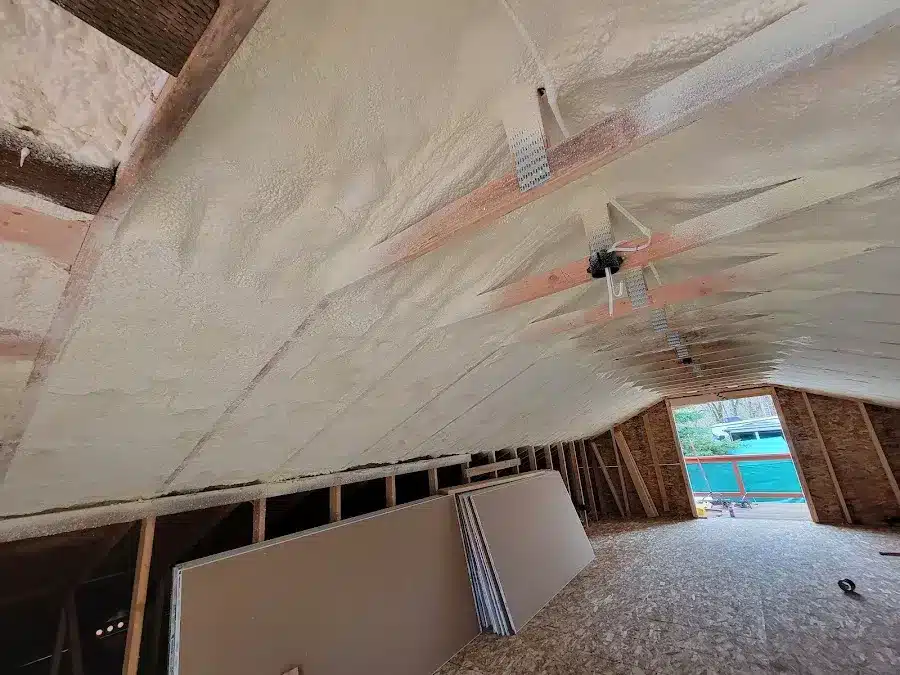
The closed-cell spray foam insulation R-value runs approximately R-6.0 to R-7.0 per inch, compared to roughly R-3.5 to R-3.8 per inch for open-cell foam. That’s the number most homeowners and builders search for first, and on paper, closed-cell wins by nearly double. But a higher closed-cell spray foam insulation R-value per inch doesn’t automatically mean better real-world performance for every job. Whole-wall R-value, moisture exposure, cavity depth, and climate zone all factor into which product actually delivers. Anyone weighing spray foam options can also dig deeper into closed-cell foam performance across different Oregon climates before deciding which one fits a specific project.
In standard 2×4 or 2×6 framed walls, the whole-wall R-value gap between the two foam types narrows considerably because of thermal bridging through wood studs. Understanding where each foam earns its keep and where it doesn’t is the difference between a well-insulated building envelope and one that wastes material and budget.
TL;DR
- Closed cell spray foam insulation r value runs roughly R-6.0–R-7.0 per inch; open-cell runs roughly R-3.5–R-3.8 per inch
- Both foam types are air-impermeable at standard application thickness
- Closed-cell qualifies as a Class II vapor retarder at 1.5 inches; open-cell stays vapor-permeable even at full cavity depth
- Whole-wall R-value differences are smaller than per-inch differences because of thermal bridging through framing
- Closed-cell is required in IECC Climate Zones 5+ for unvented attics and cathedral ceilings
- Open-cell is rated “not acceptable” for below-grade and flood-prone applications
- FEMA classifies only closed-cell spray foam as acceptable for flood-damage-resistant construction
- The right spray foam insulation ratings to prioritize depend on climate zone, cavity depth, and moisture exposure, not per-inch R-value alone
R-Value Per Inch: The Raw Numbers
R-value measures thermal resistance: how well a material resists heat flow. The higher the number, the better it insulates. Comparing closed-cell foam R-values against open-cell on a strict per-inch basis makes the gap obvious.
| Property | Open-Cell Spray Foam | Closed-Cell Spray Foam |
| R-Value Per Inch | R-3.6 (aged) | R-6.1 (aged) |
| Density | ~0.5 lb/cu ft | ~2.0 lb/cu ft |
| Cell Structure | Interconnected, open cells | Over 90% closed cells |
| Air Permeance | Air-impermeable at typical depth | Air-impermeable |
| Vapor Permeance | ~10 perms at 5″ thickness | Less than 1 perm at 2″ |
| Compressive Strength | Less than 2.0 psi | 22 psi |
| Water Absorption | Can absorb and hold water | Hydrophobic, does not absorb |
Data adapted from the U.S. Department of Energy’s Building America spray foam guideline.
A 2-inch application of closed-cell foam reaches approximately R-12, while 2 inches of open-cell delivers only about R-7.2, nearly a 2:1 advantage that matters most when cavity depth is limited.
Why Per-Inch R-Value Can Be Misleading
The spray foam R-value printed on a product data sheet measures the material in isolation; it doesn’t account for the whole wall assembly. In a typical 2×4 framed wall, roughly 25% of the wall area is wood framing, and heat flows through those studs no matter how high the insulation’s R-value is.
Installers applying closed-cell foam in a 2×4 cavity often stop around 3 inches because trimming the dense, cured foam is labor-intensive. That leaves studs partially exposed, increasing thermal bridging and reducing whole-wall performance. Open-cell foam, being softer and easier to trim, fills the full 3.5-inch cavity completely, which keeps studs covered and actually reduces thermal bridging in some cases. For a deeper look at how these differences play out in real energy bills, see this related breakdown of open-cell versus closed-cell spray foam energy efficiency.
The takeaway: the whole-wall R-value gap between a wall insulated with open-cell versus closed-cell spray foam is much smaller than the per-inch numbers suggest. Paying a premium for closed-cell in a standard stud cavity doesn’t always deliver proportional energy savings.
Performance by Application and Climate Zone
Different parts of a building envelope carry different requirements.
Frame Wall Cavities
- Cold Climates (IECC Zones 5–8): Both types work. High-density closed-cell qualifies as a Class II vapor retarder at 1.5 inches and is preferred for condensation control. Open-cell can work but typically needs an interior vapor retarder such as vapor-retardant paint.
- Hot-Humid Climates: Closed-cell is preferred for its redundant moisture control layer. Open-cell is acceptable but needs careful exterior drainage detailing and isn’t recommended behind brick veneer.
- Hot-Dry Climates: Both are preferred, since moisture concerns are minimal.
Sloped Roof Rafters and Unvented Attics
- Zones 5 and Higher: Only high-density closed-cell spray foam should be used, meeting minimum thickness requirements to prevent interior condensation.
- Zones 4 and Below: Both types are acceptable with proper moisture management.
Foundations and Below-Grade Spaces
- Open-Cell: Rated “not acceptable” below grade due to its moisture-permeable nature.
- Closed-Cell: Preferred for foundation walls, acting as both an air barrier and vapor retarder while resisting water absorption.
Band Joists and Rim Joists
- Both work well here. Closed-cell is preferred for moisture resistance, but open-cell is a cost-effective option on tighter budgets.
Whole-Wall R-Value Comparison
Consider a standard 2×6 wall with a 25% framing factor:
| Configuration | Insulation R-Value | Framing R-Value | Whole-Wall U-Factor | Whole-Wall R-Value |
| Open-cell, full 5.5″ cavity (R-3.6/in) | R-19.8 | R-7.5 | 0.049 | R-20.4 |
| Closed-cell, 3″ depth (R-6.1/in) | R-18.3 | R-5.3 | 0.055 | R-18.2 |
| Closed-cell, full 5.5″ cavity (R-6.1/in) | R-33.6 | R-7.5 | 0.039 | R-25.6 |
This example shows that 3 inches of closed-cell foam in a 2×6 cavity can actually underperform a fully filled open-cell application because exposed studs create more thermal bridging than a complete fill does.
Flood Resistance: A Critical Distinction
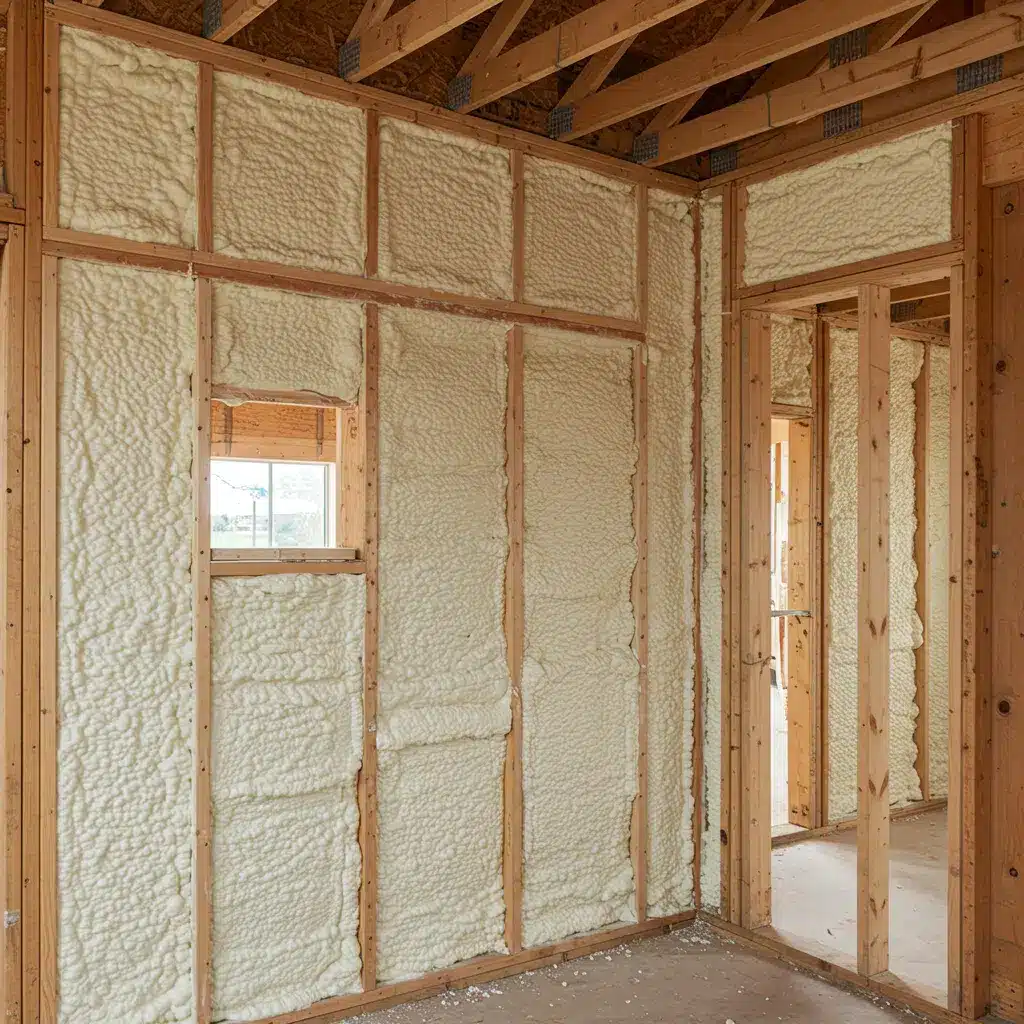
In flood-prone areas, this isn’t a close call. According to FEMA Technical Bulletin 2, closed-cell spray polyurethane foam is rated acceptable for use below the base flood elevation in Special Flood Hazard Areas, while open-cell and other inorganic insulation types are rated unacceptable.
That matters beyond designated flood zones too: basements, crawlspaces, and coastal builds all face routine moisture exposure. Closed-cell’s hydrophobic nature means it won’t absorb water, while open-cell foam can hold up to one-third of its volume in water, leading to mold and structural damage.
Real-World Application Scenarios
| Scenario | Property Type | Recommended Foam | Key Rationale |
| Unvented attic in Zone 5 | New construction | Closed-cell | Code requires high-density foam to prevent condensation |
| 2×6 wall cavity, hot-dry climate | Residential new build | Open-cell | Full cavity fill maximizes whole-wall R-value; low moisture risk |
| Basement wall in Zone 6 | Remodel | Closed-cell | Below-grade needs moisture resistance and vapor control |
| Cathedral ceiling, 2×8 depth | Mountain cabin | Closed-cell | Cold-climate condensation control |
| Band/rim joist | Commercial building | Either | Small area, high air-leakage potential |
Factors That Influence the Decision
- Climate zone: Zones 5+ require closed-cell for unvented roofs and favor it for condensation control
- Cavity depth: Shallow cavities benefit from closed-cell’s higher R-value per inch; deep cavities can hit strong totals with lower-cost open-cell
- Moisture exposure: Below-grade, flood-prone, and humid environments favor closed-cell
- Budget: Closed-cell costs more per board foot, though the per-R-value gap is smaller than it looks
- Structural needs: Closed-cell adds racking strength and can serve as structural adhesive in modular builds
- Code requirements: Local IRC/IECC adoption may mandate specific thicknesses and types
Who Closed-Cell Is Best For
- Builders in Climate Zones 5–8 needing condensation control
- Below-grade, basement, and crawlspace projects
- FEMA-designated flood hazard areas
- Unvented attic and cathedral ceiling assemblies in cold climates
- Projects needing structural reinforcement or wind uplift resistance
Where Closed-Cell Isn’t the Best Choice
- Large interior wall cavities in hot-dry or mild climates where open-cell hits code R-values at lower cost
- Budget-limited projects in warm climates with minimal whole-wall performance gaps
- Assemblies that already include continuous exterior rigid foam for vapor control
- Projects prioritizing sound attenuation, since open-cell offers better acoustic performance
Getting the Right Recommendation
Comparing the R-value of closed-cell spray foam insulation against open-cell takes more than reading numbers off a spec sheet; climate zone, cavity depth, moisture exposure, and budget all factor into the right call. For homeowners weighing options for a specific project, the closed-cell spray foam insulation page walks through installation details and where this material tends to make the most sense.
Frequently Asked Questions
Does closed-cell spray foam always outperform open-cell?
No. While closed-cell has a higher R-value per inch, whole-wall performance narrows significantly in standard framed walls due to thermal bridging through studs. In deep cavities in mild climates, open-cell can deliver comparable whole-wall R-values at lower cost.
Can open-cell spray foam be used in a basement or crawlspace?
It shouldn’t be. Open-cell is moisture-permeable and can absorb and retain water, leading to mold growth. Closed-cell is the correct choice for foundations, basements, and crawlspaces.
At what thickness does closed-cell spray foam become a vapor retarder?
Closed-cell qualifies as a Class II vapor retarder at approximately 1.5 inches, achieving a perm rating below 1.0.
Is closed-cell worth the extra cost in a warm climate?
In warm, dry climates, the added cost may not deliver proportional energy savings in standard wall cavities. It’s still worthwhile for unvented attics, flat roofs, band joists, and assemblies needing moisture control or structural reinforcement.
Why does FEMA only approve closed-cell spray foam for flood zones?
FEMA rates insulation based on its ability to withstand prolonged floodwater contact without damage. Closed-cell is hydrophobic and doesn’t absorb water, while open-cell and other insulation types absorb and retain it, leading to mold, rot, and full replacement after flooding.