

Expert Blown-In Insulation Services in Ashland, OR

If your home has uneven room temperatures, drafts, or high heating bills, upgrading the insulation in your attic or walls can help. Our professional blown-in insulation services in Ashland, OR use loose-fill cellulose or fiberglass to fill open attic floors and enclosed wall cavities, improving thermal coverage without removing large sections of drywall or plaster. We install insulation across Jackson County to help reduce winter heat loss, limit summer heat gain, and improve indoor comfort. A professional assessment can determine whether your attic needs additional insulation or your walls would benefit from dense-pack installation.
TL;DR
- Materials: Loose-fill cellulose treated with borate for fire and pest resistance, or lightweight blown fiberglass.
- Key Step: Pre-insulation air sealing with expanding foam to close hidden gaps before any fibers are blown.
- Local Savings: Cash rebates may be available through municipal programs for qualifying attic and wall insulation improvements. Eligibility depends on current program requirements.
How Ashland’s Climate Affects Home Insulation
Ashland experiences hot summers and cold winters due to its location near the Siskiyou Mountains. According to the NOAA National Centers for Environmental Information, summer temperatures can approach 100°F, while winter nights often drop below freezing. Poor insulation allows heat to enter through ceilings during summer and escape during winter, increasing heating and cooling demands. Blown-in insulation helps reduce this heat transfer and maintain more consistent indoor temperatures.
Older homes in Ashland’s Railroad District and Skidmore Academy neighborhoods may have uninsulated wall cavities or outdated insulation. The Oregon Building Codes Division provides insulation requirements for residential buildings. Blown-in cellulose or fiberglass can improve insulation coverage in attics and suitable wall cavities without major structural changes.
Custom Blown-In Insulation Solutions for Ashland Properties
Every structure requires a tailored installation approach based on joist depth, wall framing, and existing thermal levels. Implementing dedicated blown-in insulation solutions that Ashland, OR homeowners trust ensures the material stays in place and delivers its rated thermal resistance over time.
Attic Loose-Fill Caps
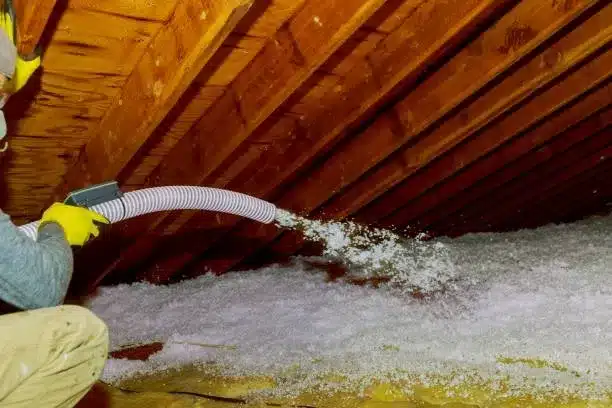
Most homes lose the majority of their conditioned air through the ceiling. We blow loose-fill cellulose or fiberglass across open joist bays, covering electrical wiring, junction boxes, and plumbing runs without leaving gaps. If your attic has older, uncompressed batts that are clean and dry, we can add a fresh cap over them. We install permanent depth rulers throughout the attic space, blowing roughly 14 to 18 inches of material to guarantee you meet the state R-49 standard after settling.
Dense-Pack Wall Retrofits
Empty exterior walls are common in pre-1970 Ashland homes. Rather than tearing out interior plaster or drywall, we use an exterior drill-and-fill method. Our crew carefully removes a course of exterior lap siding or drills small, discreet ports through the sheathing. We insert a flexible hose into each stud bay and pack borate-treated cellulose under pressure to a density of roughly 3.5 pounds per cubic foot. This high density keeps the material from settling over time, blocks air movement inside the cavity, and leaves your interior walls undisturbed. Once the cavities are full, we plug the ports and reinstall your siding.
Material Comparison
Cellulose and fiberglass offer distinct characteristics depending on your attic structure:
Feature | Loose-Fill Cellulose | Blown-In Fiberglass |
|---|---|---|
Primary Material | Recycled post-consumer paper fibers | Spun molten glass fibers |
R-Value per Inch | Roughly 3.2 to 3.7 | Roughly 2.2 to 2.7 |
Airflow Resistance | High (dense fibers slow air movement) | Low (acts more like an air filter) |
Settling Tendency | Settles 15% to 20% (adjusted at install) | Settles less than 2% |
Best Application | Dense-pack walls and general attic caps | Low-pitch roofs and weight-sensitive ceilings |

Why Air Sealing Matters Before Blown-In Insulation
Blown-in insulation reduces heat transfer but cannot stop air leaks. Gaps around recessed lights, plumbing openings, and ceiling penetrations allow warm air and moisture to enter the attic. Without proper sealing, these leaks can reduce insulation performance and increase condensation risks.
Before installing insulation, our crew seals accessible gaps using suitable materials and protects recessed fixtures where required. We also install rafter baffles near soffit vents to prevent insulation from blocking airflow. This helps maintain proper attic ventilation and improves insulation performance.
City of Ashland Electric Utility Rebates for Insulation Upgrades
Ashland operates its own municipal electric utility separate from regional energy providers like Pacific Power. To help residents lower seasonal electric loads from heating and cooling equipment, the municipal government offers cash incentives for building envelope retrofits.
According to program documentation from the City of Ashland, qualifying homeowners can receive weatherization incentives for insulation work:
- Attic Upgrades: Cash rebates between $0.26 and $0.65 per square foot when increasing insulation up to code-compliant levels.
- Wall Upgrades: Rebates of $0.66 per square foot for dense-packing previously uninsulated exterior walls.
You must coordinate with the city before work starts. A City of Ashland conservation specialist needs to complete a Home Energy Review to verify your baseline insulation levels and confirm rebate eligibility. If your home heats primarily with Avista natural gas, we can also help you direct your paperwork through Energy Trust of Oregon weatherization incentives. Working with an experienced blown-in insulation contractor in Ashland, OR ensures all prep and installation details align directly with local program standards so you capture every available credit.
Trusted Ashland, OR Blown-In Insulation Company
Proper insulation performance depends entirely on the installer’s precision. Blowing material too loosely leaves walls prone to settling pockets, while blowing an attic without air sealing wastes money. Partnering with a dedicated Ashland, OR blown-in insulation company means you get commercial-grade equipment, licensed crews, and verified standards on every project across Jackson County.
- Oregon CCB Licensing: We operate as a licensed, bonded, and insured contractor under Oregon Construction Contractors Board standards.
- Property Protection: We protect your living space from dust. Our crew uses floor drop cloths, sets up zippered containment barriers at attic access hatches, and runs negative-pressure systems to contain airborne particles during the blow.
- Verified Depth: We do not guess volume based on machine run time. We attach visible measurement gauges to joists across your attic to ensure full settled R-value compliance before we pack up our trucks.
- Thorough Cleanup: Once the installation wraps up, we run HEPA-filtered vacuums around the access hatch, leaving your home as clean as we found it.
Schedule Your Ashland Home Insulation Assessment
Stop losing conditioned air through your roof deck and empty wall bays. All Foam & Insulation, LLC provides clear on-site inspections, honest assessments, and clean installation practices across Jackson County. We will evaluate your current insulation depth, pinpoint hidden air bypasses, and outline the exact utility rebates available for your address.
All Foam & Insulation, LLC
Phone: (541) 826-9600
Email: [email protected]
Frequently Asked Questions
What settled depth is needed for R-49 blown-in attic insulation?
To achieve R-49, you need about 14 inches of settled loose-fill cellulose or 18 inches of blown fiberglass. Installers must account for natural material settling when blowing the initial layer.
Can you blow fresh insulation directly over old fiberglass batts?
Yes, as long as the old batts are dry, clean, and free of mold or rodent contamination. Crucially, all ceiling air leaks must be sealed with foam before capping.
Does dense-pack cellulose attract rodents or insects inside closed walls?
No. High-quality cellulose is treated with natural boric acid during manufacturing. This mineral additive deters common pests, inhibits wood rot and mold spores, and serves as a Class A fire retardant.
Will the blown installation process create dust inside my home?
When done properly, dust is minimal. We set up containment tents around the attic hatch, seal interior trim, and use dedicated industrial hoses that vent blower air outside.
How long does a standard residential blown-in attic retrofit take?
Most attic air-sealing and blown-in top-off jobs take one full day. Crews typically finish the prep, mechanical sealing, baffling, and material blow within four to eight hours.
Sources
- NOAA National Centers for Environmental Information – U.S. Climate Normals dataset tracking long-term regional temperature and precipitation patterns.
- Oregon Building Codes Division – 2021 Oregon Residential Specialty Code thermal envelope and flat ceiling R-49 efficiency benchmarks.
- City of Ashland – Municipal Electric Utility conservation program guidelines, rebate schedules, and pre-work home energy review rules.